
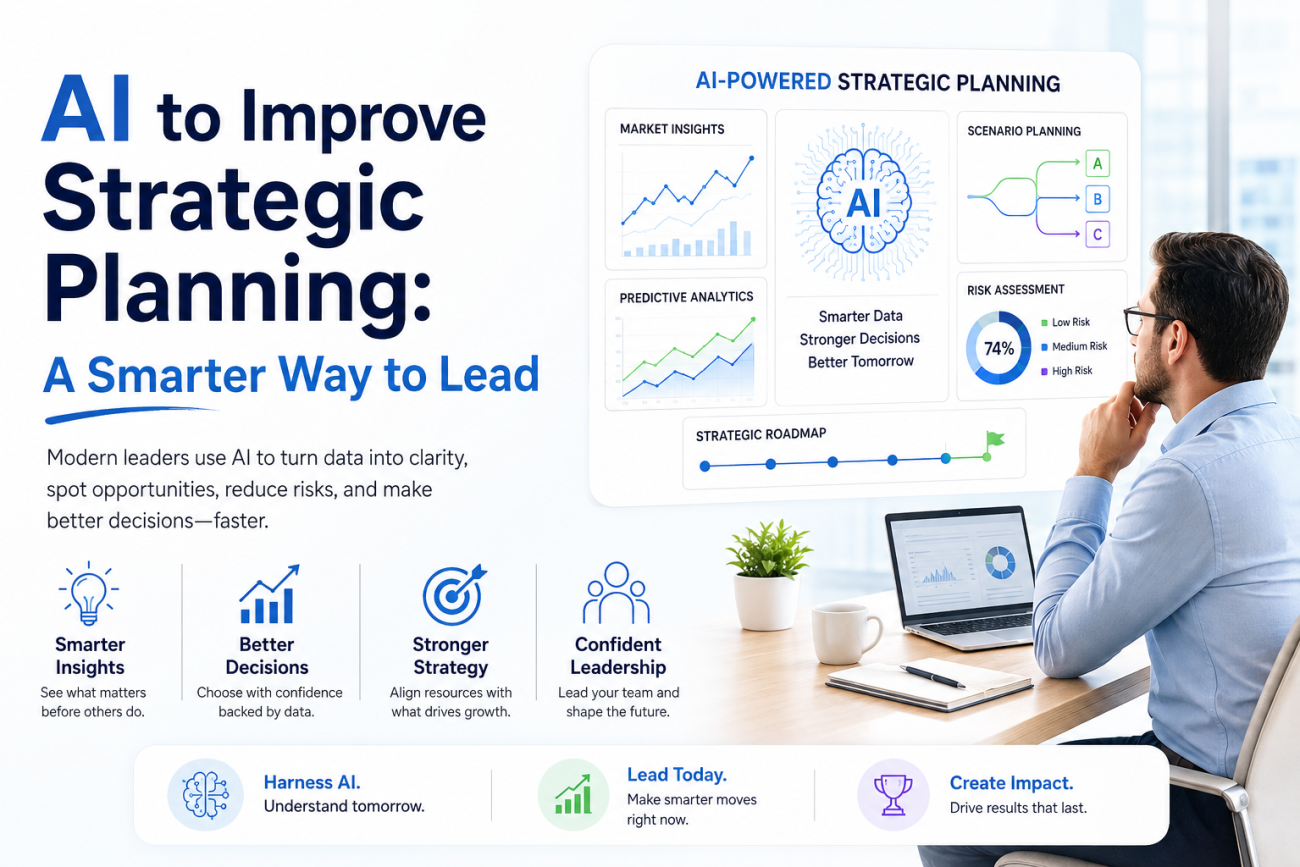
Modern leaders increasingly use SignalDX.AI to improve strategic planning because traditional planning methods can struggle to keep pace with rapidly changing markets, customer expectations, competitive pressures, and growing volumes of business data. Artificial intelligence gives decision-makers the ability to analyze information faster, identify patterns, evaluate potential scenarios, and turn complex data into actionable insights. Instead of replacing human leadership, AI can strengthen strategic thinking by helping executives make more informed, timely, and evidence-based decisions.
Why Modern Leaders Use AI to Improve Strategic Planning
Strategic planning has traditionally relied on historical performance, market research, leadership experience, and financial forecasts. These remain important, but modern organizations generate far more data than leadership teams can manually evaluate.
AI can process large datasets and identify relationships that may be difficult to discover through conventional analysis. Leaders can use these insights to understand market shifts, operational challenges, customer behavior, and emerging opportunities.
Using AI for business strategy also makes planning more dynamic. Rather than developing an annual strategy and reviewing it months later, organizations can continuously evaluate new information and adjust priorities when circumstances change.
AI to Improve Strategic Planning Through Better Data Analysis
One of the most valuable applications of AI to improve strategic planning is advanced data analysis. Businesses collect information from sales systems, customer interactions, operations, marketing campaigns, financial platforms, and external market sources.
AI-powered analytics can bring these signals together and help leadership teams identify meaningful trends.
For example, AI can help leaders:
- Detect changes in customer demand and buying behavior.
- Identify high-performing markets, products, or customer segments.
- Discover operational inefficiencies and potential cost savings.
- Compare business performance across departments or regions.
- Recognize patterns that could indicate future opportunities or risks.
This enables executives to spend less time manually reviewing information and more time interpreting insights and deciding what actions to take.
How AI Strategic Planning Improves Forecasting
Forecasting is a critical part of strategic planning. Leaders need to estimate future revenue, customer demand, resource requirements, market conditions, and potential business risks.
AI strategic planning can strengthen forecasting by analyzing historical information alongside current business signals. Machine learning models can detect patterns and update forecasts as new information becomes available.
This approach can help businesses create more responsive forecasts rather than relying entirely on static assumptions.
Predictive analytics can also support scenario planning. Leadership teams can evaluate questions such as: What happens if customer demand falls? How could a price change affect revenue? What resources might be required if the company enters a new market?
AI does not eliminate uncertainty, but it can help leaders understand possible outcomes more clearly.
AI-Powered Decision Making Helps Leaders Evaluate Options
Senior leaders regularly face decisions involving investments, expansion, pricing, product development, hiring, partnerships, and resource allocation. Each decision may involve dozens of variables.
AI-powered decision making helps organize and analyze those variables more efficiently.
AI systems can compare potential scenarios, highlight important trade-offs, and surface supporting evidence. Leaders can then combine those insights with experience, organizational knowledge, ethics, and long-term business objectives.
The strongest approach is therefore not AI replacing executive judgment. It is AI supporting leaders with better intelligence while humans retain responsibility for strategic choices.
Using AI for Business Strategy and Competitive Intelligence
Competitive intelligence is another important area where AI for business strategy can create value. Markets evolve quickly, and companies need to understand changes in competitors, customer expectations, technologies, regulations, and industry trends.
AI tools can help organizations analyze large volumes of structured and unstructured information to identify relevant developments.
For example, leaders may use AI-supported intelligence to track changing market trends, analyze customer sentiment, compare competitive positioning, or identify emerging technologies.
Having this information available earlier can help leadership teams recognize threats and opportunities before they become obvious through traditional reporting.
AI to Improve Strategic Planning and Risk Management
Every strategy contains uncertainty. Expansion into a new region, launching a product, changing pricing, or investing in technology can introduce financial and operational risks.
Using AI to improve strategic planning can help organizations identify potential risks earlier.
AI models can examine historical data and current indicators for unusual patterns or potential problems. Depending on the organization, these signals might involve declining demand, supply-chain disruptions, changing customer behavior, financial anomalies, or operational bottlenecks.
Leaders can then incorporate these risks into strategic scenarios and develop contingency plans before problems escalate.
Strategic Planning With AI Creates More Agile Organizations
Traditional strategic plans can become outdated quickly. A strategy created at the beginning of the year may need significant adjustment when economic conditions, competitors, technologies, or customer preferences change.
Strategic planning with AI supports a more continuous approach.
Instead of reviewing performance only during quarterly or annual planning sessions, leadership teams can monitor important signals and reassess assumptions more frequently. When meaningful changes occur, executives can adjust investments, resources, and priorities.
This creates a strategic planning process that is more responsive to real-world conditions.
The Role of Human Leadership in AI Strategic Planning
Despite its capabilities, AI should not make every strategic decision independently. Algorithms may produce misleading recommendations when information is incomplete, biased, outdated, or poorly interpreted.
Modern leaders need to combine AI insights with human judgment.
Effective artificial intelligence in strategic planning requires executives to ask important questions: Where did the data come from? What assumptions influence the model? What information might be missing? What are the ethical or organizational consequences of a recommendation?
Leadership teams should also establish governance practices around data quality, security, privacy, transparency, and accountability.
The objective should be augmented intelligence—AI strengthens human decision-making rather than removing people from the strategic process.
How Leaders Can Start Using AI to Improve Strategic Planning
Organizations do not need to transform their entire planning process at once. A focused approach can make AI adoption easier and more measurable.
Leaders can begin by identifying strategic decisions where better information would have the greatest impact. They can then evaluate available data, choose appropriate AI tools, establish measurable objectives, and test solutions on specific business problems.
A practical starting framework includes:
- Define the strategic challenge. Determine which decision or planning process needs better intelligence.
- Evaluate available data. Ensure relevant information is reliable, accessible, and suitable for analysis.
- Select the right AI capabilities. Match technology to a defined business need rather than adopting AI simply because it is available.
- Keep humans involved. Treat AI recommendations as decision support rather than unquestionable answers.
- Measure business impact. Track whether AI improves forecasting, decision speed, efficiency, risk identification, or strategic outcomes.
The Future of AI-Powered Strategic Planning
As AI technologies mature, strategic planning is likely to become increasingly continuous, predictive, and data-driven. Leaders will be able to analyze more information, explore scenarios faster, and respond to changes with greater confidence.
However, competitive advantage will not come simply from having access to artificial intelligence. Many organizations will have similar technologies. The difference will come from how effectively leaders connect AI-generated intelligence with business expertise, strategic priorities, and responsible decision-making.
Organizations that successfully use AI to improve strategic planning can build a clearer understanding of their environment, identify opportunities earlier, respond to risks faster, and make better-informed decisions. In a business landscape defined by constant change, combining human leadership with AI-powered intelligence can create a stronger and more adaptable approach to long-term strategy.