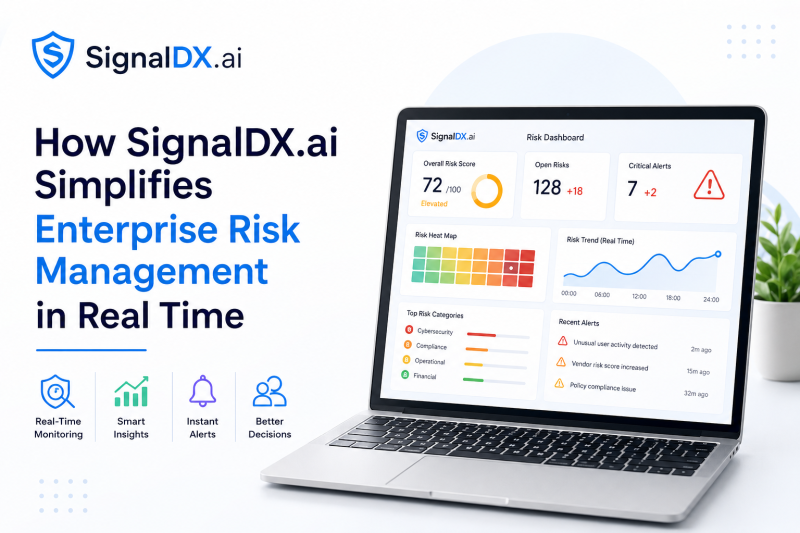
In today’s rapidly changing business environment, How SignalDX.ai Simplifies Enterprise Risk Management has become an important topic for organizations seeking better visibility, stronger compliance, and faster decision-making. Businesses face increasing cyber threats, regulatory changes, financial uncertainties, operational disruptions, and reputational risks every day. Traditional risk management methods often rely on manual processes and disconnected data, making it difficult for leaders to identify emerging threats before they become costly problems.
SignalDX.ai transforms enterprise risk management by using artificial intelligence, predictive analytics, and continuous monitoring to help organizations detect risks earlier, prioritize responses, and make informed business decisions. Instead of reacting after incidents occur, businesses can proactively identify warning signals, automate workflows, and strengthen resilience across every department.
This guide explains how SignalDX.ai simplifies enterprise risk management, the benefits of AI-powered risk intelligence, and why modern organizations are adopting intelligent risk management platforms to stay ahead of uncertainty.
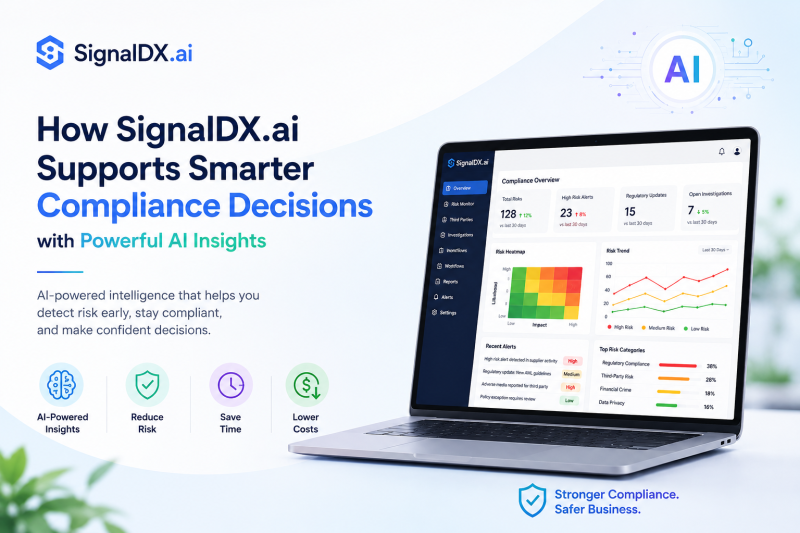
Organizations today face an increasingly complex regulatory environment where compliance requirements continue to evolve across industries. How SignalDX.ai Supports Smarter Compliance Decisions is becoming an important topic for businesses looking to reduce compliance risks, automate monitoring, and improve decision-making. Traditional compliance processes often rely on manual reviews, disconnected data, and reactive investigations, making it difficult to identify risks before they become costly problems. SignalDX.ai transforms compliance management by providing AI-driven intelligence, continuous monitoring, and actionable insights that help organizations make faster, more informed compliance decisions.
Whether organizations operate in financial services, healthcare, insurance, manufacturing, or government sectors, maintaining regulatory compliance requires more than checking boxes. It requires continuous visibility into changing risks, automated workflows, and real-time intelligence that empowers leadership to act confidently.
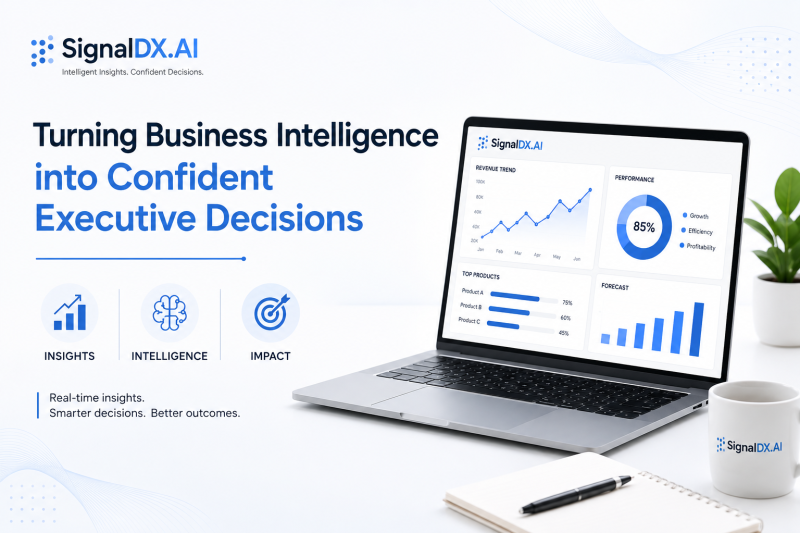
In today’s fast-moving business environment, Turning Business Intelligence into Confident Executive Decisions has become essential for organizations that want to stay competitive, reduce uncertainty, and accelerate growth. Modern leaders no longer have the luxury of relying on intuition alone. They need timely, accurate, and actionable insights that transform complex data into strategic direction. SignalDX.AI is a business intelligence empowers executives with the visibility they need to identify risks, uncover opportunities, improve operational performance, and make informed decisions with confidence.
Organizations generate enormous volumes of data every day from customers, operations, finance, supply chains, compliance systems, and digital channels. However, data only becomes valuable when it is analyzed effectively and presented in a way that supports executive decision-making. This is where business intelligence solutions play a critical role by converting raw information into meaningful insights that drive measurable business outcomes.
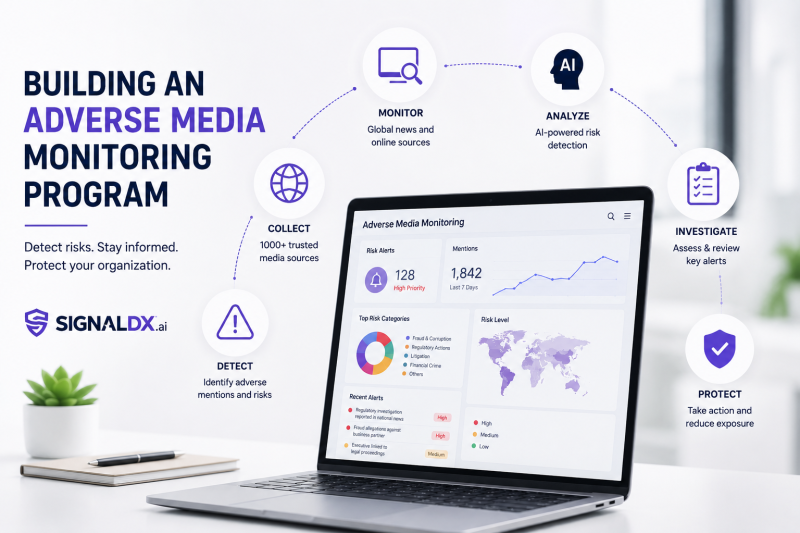
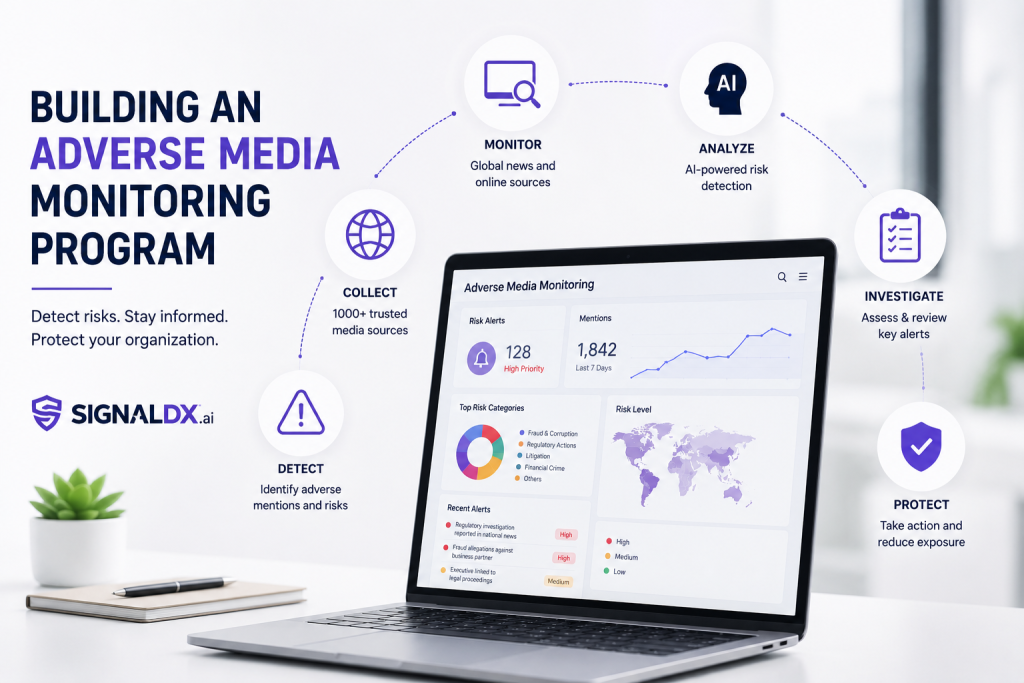
In today’s increasingly connected world, Building an Adverse Media Monitoring Program has become a critical priority for organizations that want to identify hidden risks before they become costly crises. Businesses across financial services, healthcare, insurance, manufacturing, government, and enterprise sectors rely on continuous adverse media monitoring to detect reputational threats, compliance violations, fraud indicators, sanctions exposure, cyber risks, litigation, and emerging operational concerns. SignalDX.ai enables organizations to automate adverse media intelligence using AI-powered monitoring, real-time risk detection, entity resolution, and contextual analysis, helping decision-makers identify meaningful signals long before traditional monitoring methods can react.
Why Building an Adverse Media Monitoring Program Matters
Organizations today operate in an environment where information spreads instantly across thousands of online sources. News articles, regulatory announcements, court filings, investigative journalism, blogs, industry publications, and social media can all reveal warning signs about vendors, suppliers, executives, customers, investors, competitors, and business partners.
Traditional due diligence performed once during onboarding is no longer enough. Risk profiles evolve daily, making continuous monitoring essential.
Building an Adverse Media Monitoring Program allows organizations to move from reactive risk management to proactive intelligence. Instead of discovering issues after they damage reputation or create regulatory exposure, companies receive early warnings that enable informed action.
For regulated industries, adverse media monitoring has become an essential component of Know Your Customer (KYC), Anti-Money Laundering (AML), Third-Party Risk Management (TPRM), Vendor Risk Management (VRM), Environmental, Social and Governance (ESG) oversight, and enterprise risk management.
SignalDX.ai transforms this process by combining artificial intelligence, natural language processing, entity matching, and contextual risk scoring into one unified intelligence platform.
Understanding Adverse Media Monitoring
Adverse media monitoring refers to continuously searching public information sources for negative information related to individuals, companies, suppliers, vendors, executives, politically exposed persons, customers, or business partners.
The goal is not simply collecting negative news.
Instead, effective monitoring identifies credible information that could indicate financial crime, fraud, corruption, regulatory violations, litigation, sanctions exposure, cybersecurity incidents, operational failures, environmental issues, or reputational threats.
Modern adverse media intelligence goes beyond headlines by evaluating context, credibility, relevance, severity, frequency, and timing.
SignalDX.ai helps organizations distinguish meaningful risks from routine news noise using AI-driven contextual analysis.
The Growing Importance of Continuous Risk Intelligence
Business risks now emerge much faster than traditional compliance programs can detect them.
A supplier may become involved in financial fraud.
A senior executive could become the subject of regulatory investigation.
A healthcare organization might experience a major data breach.
A manufacturing partner may violate environmental regulations.
A logistics provider could become subject to international sanctions.
Each event has the potential to disrupt operations, damage reputation, trigger compliance reviews, or expose organizations to significant financial loss.
Building an Adverse Media Monitoring Program ensures these developments are detected quickly, allowing risk teams to investigate before problems escalate.
Challenges with Manual Adverse Media Reviews
Many organizations still rely on manual internet searches performed periodically by analysts.
Although this approach worked years ago, it no longer scales.
Thousands of new articles are published every minute.
Multiple languages complicate global monitoring.
Names often produce false matches.
Information changes constantly.
Analysts spend enormous time reviewing irrelevant articles.
Manual monitoring also introduces inconsistency because different reviewers may interpret the same article differently.
SignalDX.ai automates these repetitive tasks while ensuring consistent evaluation across every monitored entity.
Key Objectives of Building an Adverse Media Monitoring Program
An effective monitoring program supports several strategic objectives.
It strengthens regulatory compliance.
It improves third-party due diligence.
It enhances executive risk oversight.
It supports enterprise risk management.
It reduces financial crime exposure.
It identifies emerging operational threats.
It protects corporate reputation.
It enables faster investigations.
Rather than operating as an isolated compliance activity, adverse media monitoring becomes an enterprise-wide intelligence capability supporting procurement, legal, compliance, cybersecurity, finance, internal audit, and executive leadership.
Building an Adverse Media Monitoring Program with AI
Artificial intelligence has fundamentally transformed adverse media monitoring.
Instead of relying solely on keyword searches, AI understands context.
Modern AI systems recognize entities despite spelling variations.
They identify relationships between organizations.
They distinguish unrelated individuals with identical names.
They classify article topics.
They estimate risk severity.
They prioritize alerts based on business impact.
SignalDX.ai combines machine learning with advanced language models to deliver intelligent risk insights instead of overwhelming analysts with thousands of raw search results.
Identifying Reliable Data Sources
Building an Adverse Media Monitoring Program begins with selecting comprehensive information sources.
High-quality monitoring includes international news organizations, local newspapers, regulatory agencies, government publications, court records, enforcement databases, sanctions announcements, corporate disclosures, investigative journalism, trade publications, industry reports, cybersecurity advisories, financial news, environmental reports, NGO publications, and reputable online media.
Coverage diversity improves detection accuracy while reducing blind spots.
SignalDX.ai continuously monitors a wide range of trusted sources to maximize visibility across the global risk landscape.
Entity Resolution Improves Detection Accuracy
One of the biggest challenges in adverse media monitoring involves identifying the correct individual or organization.
Many businesses share similar names.
Individuals frequently have identical names.
Executives may appear under abbreviated titles.
Organizations may operate through subsidiaries.
Without accurate entity resolution, false positives increase dramatically.
SignalDX.ai applies AI-powered entity matching to connect articles with the correct monitored entity while reducing irrelevant alerts.
Risk Categorization Enhances Decision Making
Not every negative article represents the same level of concern.
An environmental fine differs significantly from organized financial crime.
Risk categorization enables organizations to prioritize investigations.
Common categories include fraud, corruption, bribery, sanctions, money laundering, cyber incidents, regulatory enforcement, litigation, ESG violations, labor disputes, environmental issues, executive misconduct, political exposure, financial instability, and operational disruption.
SignalDX.ai automatically classifies adverse media into meaningful risk categories that support rapid assessment.
Prioritizing Alerts with Risk Scoring
One challenge with continuous monitoring is alert fatigue.
Receiving hundreds of notifications each day makes meaningful investigation difficult.
Intelligent risk scoring solves this problem.
Each alert receives a severity assessment based on source credibility, publication frequency, regulatory significance, entity importance, geographic relevance, historical activity, and contextual indicators.
SignalDX.ai delivers prioritized intelligence so analysts focus first on the highest-risk events.
Integrating Adverse Media Monitoring into Compliance
Compliance teams increasingly depend on continuous monitoring rather than one-time screening.
Customer onboarding should include ongoing monitoring.
Vendor assessments require continuous visibility.
Executive leadership should receive strategic intelligence.
Procurement teams benefit from supplier monitoring.
Legal teams can identify litigation risks earlier.
SignalDX.ai integrates adverse media monitoring directly into enterprise compliance workflows.
Supporting Third-Party Risk Management
Third-party relationships represent one of the fastest-growing enterprise risk categories.
Organizations often work with thousands of suppliers, contractors, consultants, distributors, logistics providers, software vendors, and strategic partners.
Each relationship introduces operational, financial, regulatory, cybersecurity, and reputational exposure.
Building an Adverse Media Monitoring Program enables continuous oversight throughout the vendor lifecycle rather than relying only on initial onboarding reviews.
Financial institutions face increasing regulatory expectations regarding customer monitoring.
Adverse media intelligence strengthens KYC by identifying emerging risks after onboarding.
Customers involved in criminal investigations, regulatory enforcement, sanctions activity, fraud allegations, or financial misconduct can be identified much earlier.
Continuous monitoring supports ongoing compliance while reducing manual investigative workload.
SignalDX.ai enhances KYC programs through AI-powered monitoring and contextual intelligence.
Improving Anti-Money Laundering Investigations
AML investigations rely heavily on identifying external information.
Adverse media provides valuable context for suspicious transaction investigations.
News about corruption, organized crime, fraud schemes, shell companies, or sanctions violations helps investigators understand broader risk exposure.
SignalDX.ai accelerates AML investigations by automatically correlating adverse media with monitored entities.
Media reports involving executive misconduct, ethics violations, insider trading, discrimination claims, regulatory investigations, or public controversies can directly affect investor confidence.
Continuous executive monitoring provides leadership teams with early visibility into emerging issues.
SignalDX.ai delivers executive risk intelligence before situations escalate.
Enhancing Supply Chain Visibility
Global supply chains have become increasingly complex.
Suppliers operate across multiple countries, regulatory environments, and political jurisdictions.
Adverse media monitoring identifies disruptions related to labor violations, environmental incidents, cyberattacks, transportation failures, political instability, corruption, and financial distress.
Internal audit benefits from centralized evidence.
SignalDX.ai connects adverse media intelligence with broader enterprise risk management programs.
Regulatory Expectations Continue to Increase
Global regulators increasingly expect organizations to perform ongoing monitoring rather than periodic reviews.
Financial institutions, insurance providers, healthcare organizations, multinational corporations, government agencies, and critical infrastructure operators all face growing compliance requirements.
Continuous adverse media monitoring demonstrates proactive risk management and supports regulatory expectations.
SignalDX.ai helps organizations remain compliant while improving operational efficiency.
Future Trends in Adverse Media Intelligence
Artificial intelligence will continue transforming adverse media monitoring through multilingual analysis, predictive intelligence, graph analytics, relationship mapping, behavioral modeling, generative AI summarization, automated investigations, explainable AI, and real-time global event detection.
Organizations adopting AI-driven monitoring today position themselves to respond faster to tomorrow’s risks.
SignalDX.ai continues advancing intelligent risk detection to help organizations stay ahead of rapidly evolving global threats.
Why SignalDX.ai Is the Right Platform
Building an Adverse Media Monitoring Program requires more than collecting news articles. Organizations need intelligent risk detection, contextual analysis, automated workflows, accurate entity resolution, continuous monitoring, and actionable insights. SignalDX.ai delivers all these capabilities within a unified AI-powered risk intelligence platform.
By combining artificial intelligence, machine learning, natural language processing, and advanced analytics, SignalDX.ai enables organizations to identify emerging risks faster, reduce manual investigations, improve compliance, strengthen third-party risk management, and make confident business decisions based on trusted intelligence.
Conclusion
Building an Adverse Media Monitoring Program is no longer optional for organizations operating in today’s rapidly changing risk environment. Continuous monitoring provides early visibility into reputational threats, financial crime, regulatory actions, cyber incidents, supplier risks, executive misconduct, and operational disruptions before they develop into major business problems.
Modern organizations require more than keyword searches and manual internet reviews. They need intelligent platforms capable of analyzing massive volumes of information, prioritizing meaningful alerts, reducing false positives, and delivering actionable insights in real time. SignalDX.ai empowers compliance teams, risk professionals, legal departments, procurement leaders, and executive decision-makers with AI-driven adverse media intelligence that transforms scattered public information into strategic business value.
As regulatory expectations continue to grow and risk landscapes become increasingly complex, organizations that invest in AI-powered adverse media monitoring will be better positioned to protect their reputation, strengthen compliance, improve resilience, and make faster, more informed decisions. With SignalDX.ai, adverse media monitoring becomes a strategic advantage that helps organizations stay ahead of emerging risks while building long-term trust and confidence.