
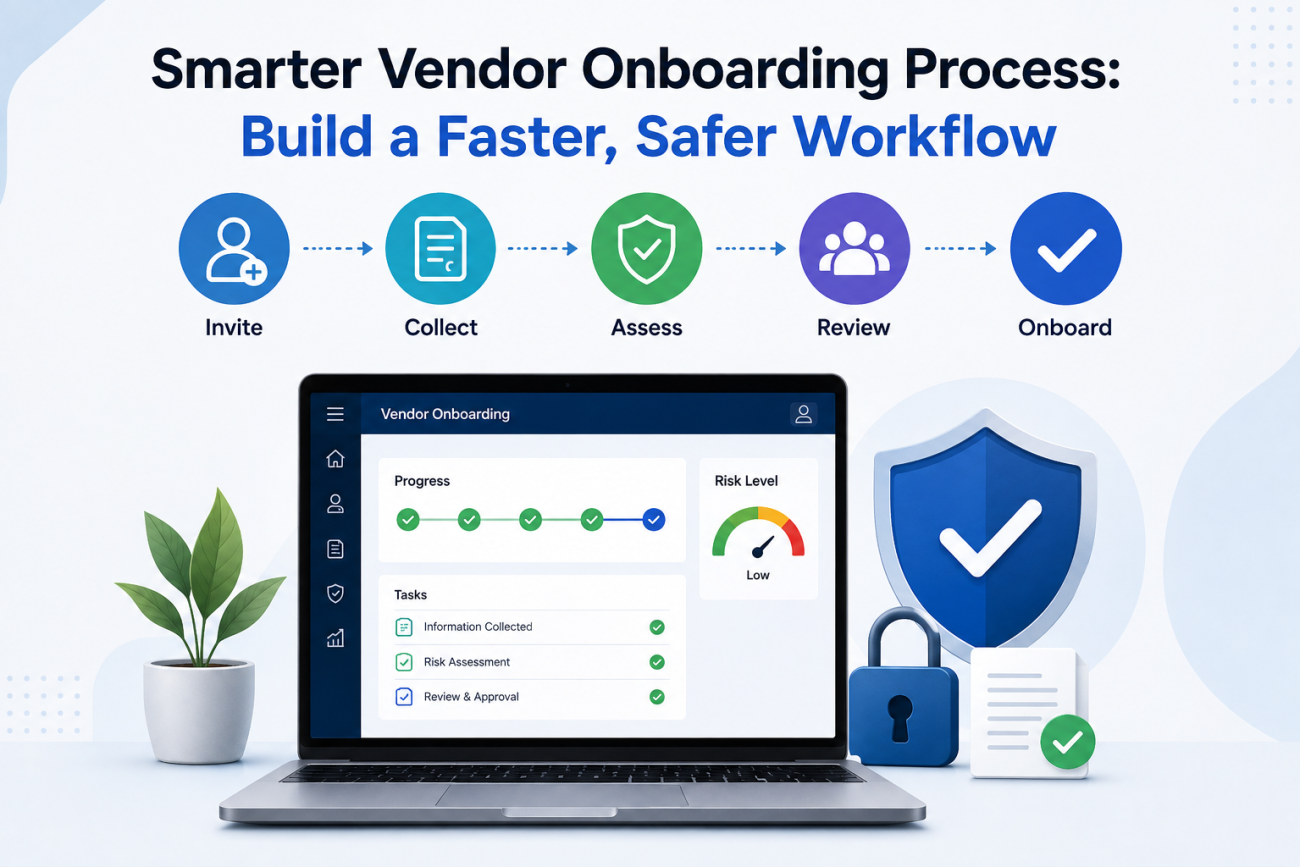
A smarter vendor onboarding process helps organizations bring new suppliers and service providers into their ecosystem faster while maintaining security, compliance, and operational control. As businesses work with growing numbers of third-party vendors, traditional onboarding methods built around emails, spreadsheets, and manual approvals can create unnecessary delays and risk. By creating a structured, automated, and data-driven vendor onboarding process, organizations can improve vendor relationships, reduce administrative work, strengthen compliance, and gain greater visibility into third-party risk.
What Is a Smarter Vendor Onboarding Process?
A smarter vendor onboarding process is a standardized workflow for collecting, validating, reviewing, approving, and maintaining vendor information. Instead of relying on disconnected documents and repetitive manual tasks, businesses can establish a centralized process that guides vendors and internal teams through every onboarding requirement.
An effective process may include vendor registration, business verification, tax and banking information, security assessments, compliance documentation, contracts, risk reviews, approvals, and ongoing monitoring.
The objective is not simply to onboard vendors faster. It is to create a reliable vendor management framework where every third party is evaluated consistently before gaining access to company systems, sensitive information, payments, or business operations.
Why Vendor Onboarding Needs to Be Smarter
Vendor ecosystems have become increasingly complex. A company may depend on software providers, contractors, consultants, logistics companies, marketing agencies, financial services providers, and many other external partners.
Every new relationship introduces information that needs to be collected and verified. It may also introduce cybersecurity, financial, operational, regulatory, or reputational risks.
When vendor onboarding is managed manually, organizations commonly experience several problems:
- Long approval cycles caused by missing information and repeated follow-ups.
- Inconsistent vendor due diligence across departments.
- Limited visibility into vendor risk and onboarding status.
- Duplicate vendor records and outdated documentation.
- Compliance gaps caused by expired certificates or incomplete assessments.
- Significant administrative work for procurement, finance, security, and legal teams.
A smarter workflow addresses these challenges by creating a consistent process from vendor request through final approval.
How to Build an Efficient Vendor Onboarding Workflow
Building an effective vendor onboarding workflow starts with understanding what information is actually required and which teams need to review it.
1. Standardize Vendor Data Collection
Start with a standardized vendor intake process. Vendors should provide required information through a structured form or centralized platform rather than sending documents through multiple email threads.
Typical information can include company details, primary contacts, tax information, banking details, certifications, insurance documents, data-processing information, security documentation, and regulatory requirements.
Standardization makes vendor information easier to review, compare, search, and maintain.
2. Use Risk-Based Vendor Assessments
Not every vendor represents the same level of risk. A catering provider, for example, should not necessarily go through the same cybersecurity assessment as a cloud provider processing confidential customer information.
A risk-based vendor onboarding process can classify vendors according to factors such as:
- Type of service provided.
- Access to sensitive or confidential data.
- Access to internal systems.
- Financial impact and contract value.
- Geographic or regulatory exposure.
- Business criticality.
Higher-risk vendors can then receive additional security, compliance, legal, or financial reviews while lower-risk relationships move through a streamlined process.
Automate Vendor Onboarding and Approval Workflows
Automation can eliminate many of the repetitive tasks that make onboarding slow.
An automated vendor onboarding process can route submissions to the correct stakeholders, trigger approval requests, identify missing information, send reminders, and maintain a clear audit trail.
For example, a vendor handling customer information might automatically trigger a security questionnaire and privacy review. A high-value contract might be routed to finance and legal teams. A low-risk vendor could follow a shorter approval path.
This approach reduces manual coordination without eliminating necessary oversight.
Create Clear Approval Responsibilities
A common cause of onboarding delays is uncertainty about who needs to approve what. Organizations should define responsibilities for procurement, information security, legal, finance, privacy, and business owners.
Each stakeholder should understand the conditions that require their approval and the information they need to make a decision.
Clear ownership helps prevent vendor requests from sitting in inboxes without action and makes it easier to identify bottlenecks.
Integrate Compliance Into Vendor Onboarding
Compliance should be part of onboarding from the beginning rather than treated as a final administrative check.
Depending on the organization and vendor relationship, due diligence may involve security certifications, privacy requirements, insurance documentation, financial checks, sanctions screening, contractual requirements, or industry-specific regulations.
A centralized third-party risk management process helps organizations document these checks consistently and retain evidence for audits.
Automated alerts can also help teams identify documents approaching expiration so compliance does not end when onboarding is completed.
Create a Centralized Vendor Record
Once a vendor has been approved, its information should remain accessible in a centralized system.
A complete vendor record can contain contracts, questionnaires, certificates, risk classifications, approval history, contacts, renewal dates, supporting documents, and previous assessments.
Centralization gives procurement and risk teams a clearer view of the organization’s vendor ecosystem while reducing the possibility of teams working from outdated documents.
It also creates a foundation for stronger vendor lifecycle management.
Extend Vendor Management Beyond Initial Onboarding
Vendor risk changes over time. A supplier may begin processing new categories of data, expand its services, experience a security incident, change ownership, or allow an important certification to expire.
For this reason, a smarter onboarding strategy should connect directly with ongoing vendor risk management.
Organizations can establish periodic reviews based on vendor risk levels. Critical or high-risk vendors may require more frequent reassessment, while lower-risk suppliers can follow longer review cycles.
Monitoring vendors throughout the relationship helps organizations identify emerging issues rather than waiting until contract renewal or an audit.
Measure Vendor Onboarding Performance
A process cannot be improved effectively without measuring it. Organizations should establish metrics that reveal both operational efficiency and risk-management effectiveness.
Useful vendor onboarding metrics include average onboarding time, approval turnaround time, percentage of incomplete submissions, number of manual follow-ups, vendors by risk tier, overdue reviews, and compliance-document expiration rates.
Tracking these metrics can reveal where workflows are slowing down and where additional automation or process improvements will have the greatest impact.
Benefits of a Smarter Vendor Onboarding Process
Organizations that modernize vendor onboarding can achieve benefits across procurement, compliance, security, and business operations.
Faster onboarding allows business teams to begin working with approved vendors sooner. Standardized due diligence improves consistency. Automated workflows reduce administrative effort, while centralized vendor information creates greater transparency.
Most importantly, smarter onboarding helps organizations balance speed with appropriate control. Instead of viewing risk management as an obstacle to procurement, organizations can build risk checks directly into efficient workflows.
Build a Scalable Vendor Onboarding Strategy
As an organization grows, managing third parties through spreadsheets, shared inboxes, and disconnected documents becomes increasingly difficult. A smarter vendor onboarding process replaces fragmented activities with structured data collection, risk-based assessments, automated approvals, centralized records, and continuous vendor monitoring.
For organizations looking to strengthen third-party governance, the goal should be a process that is easy for vendors to complete and easy for internal teams to manage.
By combining automation, standardized due diligence, clear ownership, and ongoing monitoring, businesses can onboard vendors more efficiently while maintaining visibility into the risks that matter.