
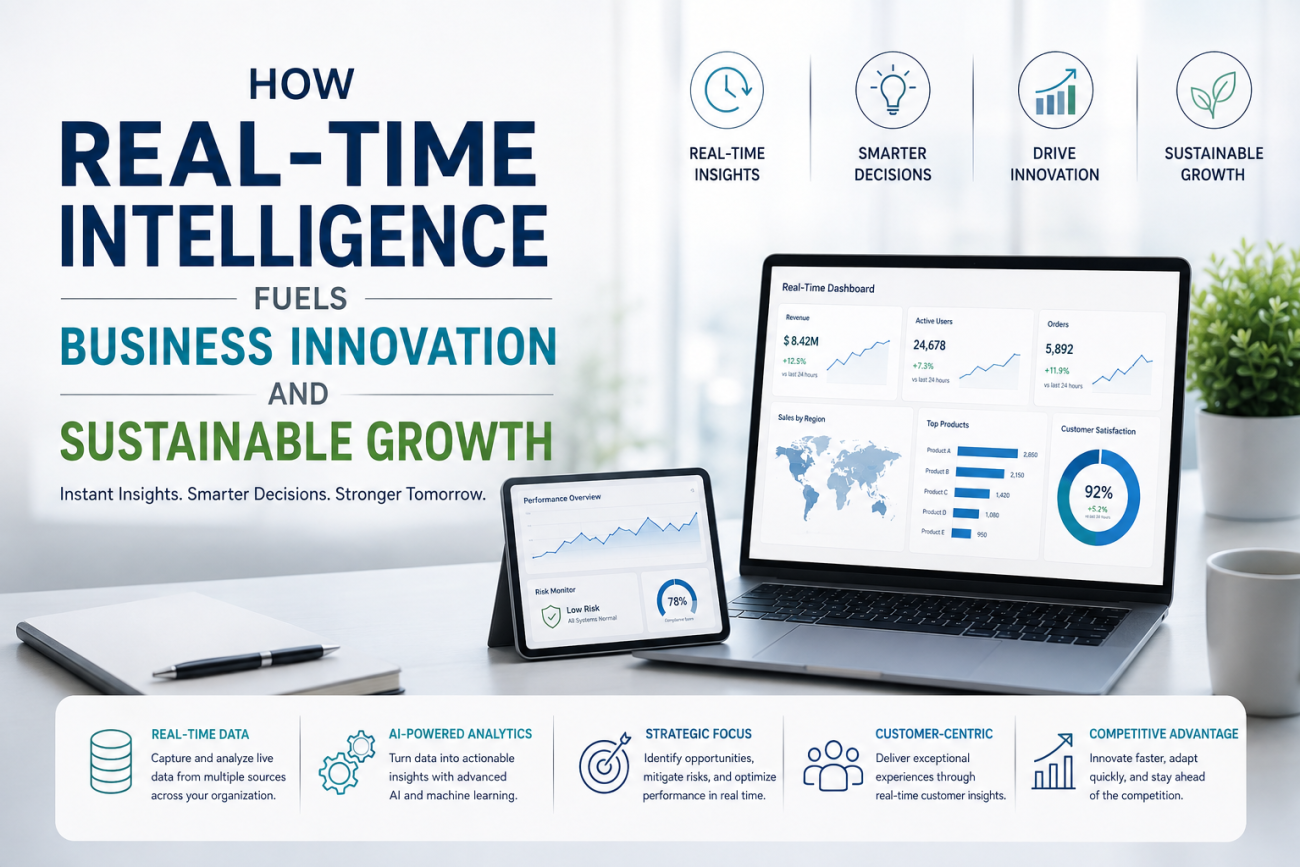
In today’s fast-changing digital economy, How Real-Time Intelligence Supports Business Innovation with SignalDX.ai has become one of the most important questions for business leaders. Organizations that leverage real-time intelligence can make faster decisions, identify new opportunities, reduce risks, and innovate ahead of competitors. Instead of relying on outdated reports or historical data, companies now use live insights powered by AI, analytics, and automation to transform every aspect of their business.
Whether it’s monitoring customer behavior, tracking operational performance, or detecting market changes, real-time intelligence empowers organizations to stay proactive instead of reactive. Businesses that embrace this technology are better positioned to innovate, improve customer experiences, and drive sustainable growth.
What Is Real-Time Intelligence?
Real-time intelligence refers to the process of collecting, analyzing, and delivering data immediately as events occur. Unlike traditional reporting systems that rely on daily or weekly updates, real-time intelligence continuously processes information to provide instant insights.
Businesses can gather data from multiple sources including:
- Customer interactions
- IoT devices
- Financial systems
- Supply chains
- Social media
- Operational software
- CRM platforms
- ERP systems
Advanced AI platforms analyze this information instantly, enabling leaders to respond faster to opportunities and potential threats.
Why Business Innovation Depends on Real-Time Intelligence
Innovation requires accurate information and fast decision-making. Organizations that wait days or weeks for reports often miss valuable opportunities.
Real-time intelligence helps businesses:
- Discover emerging trends
- Understand customer behavior instantly
- Launch products faster
- Improve operational efficiency
- Reduce business risks
- Support data-driven innovation
Instead of making assumptions, leaders make informed decisions backed by live business intelligence.
Benefits of Real-Time Intelligence for Business Innovation
Faster Decision Making
One of the biggest advantages of real-time intelligence is speed.
Traditional business reporting often creates delays because information must be collected, cleaned, and analyzed before executives can review it.
With live dashboards and AI-powered analytics, decision-makers receive immediate updates, allowing them to respond quickly.
Examples include:
- Price adjustments
- Marketing optimization
- Supply chain changes
- Inventory management
- Customer support improvements
Fast decisions often create competitive advantages.
Better Customer Experiences
Today’s customers expect personalized and responsive experiences.
Real-time intelligence allows businesses to understand:
- Customer preferences
- Buying behavior
- Website activity
- Product interests
- Service interactions
Using these insights, companies can:
- Personalize recommendations
- Improve customer service
- Reduce response times
- Increase customer satisfaction
- Build stronger relationships
Businesses that understand customers in real time consistently outperform competitors.
Encouraging Innovation Across Departments
Innovation isn’t limited to product development.
Real-time intelligence supports innovation across:
Marketing
Marketing teams monitor campaign performance instantly and optimize advertising based on live results.
Sales
Sales teams identify high-value prospects and prioritize opportunities using real-time insights.
Operations
Operations managers monitor production, logistics, and resource utilization continuously.
Human Resources
HR departments use workforce analytics to improve productivity and employee engagement.
Finance
Finance teams monitor spending, detect unusual transactions, and forecast revenue more accurately.
Every department becomes more agile and data-driven.
How AI Enhances Real-Time Intelligence
Artificial Intelligence plays a major role in modern business intelligence.
Instead of simply displaying data, AI can:
- Predict future outcomes
- Detect hidden patterns
- Identify anomalies
- Recommend actions
- Automate reporting
- Forecast demand
- Prioritize risks
AI transforms raw information into actionable intelligence.
This allows leaders to spend less time analyzing spreadsheets and more time making strategic decisions.
Real-Time Intelligence Improves Risk Management
Business innovation requires taking calculated risks.
However, organizations must identify problems before they become crises.
Real-time intelligence continuously monitors:
- Compliance risks
- Cybersecurity threats
- Operational disruptions
- Financial irregularities
- Vendor performance
- Market volatility
Instead of reacting after damage occurs, businesses can respond immediately.
This proactive approach protects innovation initiatives while reducing operational risk.
Driving Smarter Product Innovation
Customer expectations evolve rapidly.
Companies that understand changing customer preferences develop better products.
Real-time intelligence helps organizations:
- Analyze customer feedback
- Monitor product usage
- Track feature adoption
- Measure customer satisfaction
- Identify improvement opportunities
Product teams can quickly adjust development priorities based on actual customer behavior rather than assumptions.
The result is faster innovation and more successful product launches.
Improving Supply Chain Innovation
Supply chains have become increasingly complex.
Real-time intelligence helps businesses monitor:
- Inventory levels
- Shipping status
- Supplier performance
- Production schedules
- Delivery timelines
If disruptions occur, organizations can immediately:
- Find alternative suppliers
- Adjust inventory
- Reroute shipments
- Notify customers
- Reduce operational downtime
A smarter supply chain supports continuous business innovation.
Supporting Data-Driven Leadership
Modern executives need visibility into every part of their organization.
Real-time dashboards provide:
- Revenue performance
- Customer trends
- Sales forecasts
- Operational metrics
- Financial health
- Risk indicators
Instead of waiting for monthly reports, leaders gain continuous awareness.
This enables:
- Better strategic planning
- Faster investment decisions
- More confident leadership
- Stronger business performance
Real-Time Intelligence Creates Competitive Advantages
Companies using live intelligence often outperform competitors because they can:
- React faster
- Innovate continuously
- Reduce costs
- Improve customer satisfaction
- Launch products sooner
- Identify new revenue opportunities
Businesses relying on outdated reporting frequently struggle to keep pace with changing markets.
Real-time intelligence transforms speed into a competitive advantage.
Industry Applications of Real-Time Intelligence
Healthcare
Healthcare providers monitor patient data in real time, improving treatment quality and operational efficiency.
Manufacturing
Manufacturers monitor equipment performance to reduce downtime and improve productivity.
Retail
Retail businesses track customer purchasing behavior and optimize pricing instantly.
Banking
Financial institutions detect fraudulent transactions immediately while improving customer experiences.
Logistics
Transportation companies optimize delivery routes using live traffic and shipment information.
Technology
Software companies monitor application performance and customer usage to improve products continuously.
Key Technologies Behind Real-Time Intelligence
Several technologies enable real-time intelligence, including:
- Artificial Intelligence (AI)
- Machine Learning (ML)
- Cloud Computing
- Predictive Analytics
- Big Data Platforms
- Internet of Things (IoT)
- Business Intelligence Software
- Automation Platforms
- Data Streaming Technologies
Together, these technologies create an intelligent business ecosystem capable of responding instantly to change.
Challenges When Implementing Real-Time Intelligence
Although the benefits are significant, organizations may encounter challenges such as:
Data Quality
Poor-quality data leads to inaccurate insights.
Integration
Connecting multiple business systems can be complex.
Security
Businesses must protect sensitive information with strong cybersecurity practices.
Employee Adoption
Teams require training to use new intelligence platforms effectively.
Scalability
Organizations should choose solutions capable of growing alongside their business.
Proper planning helps overcome these implementation challenges.
Best Practices for Using Real-Time Intelligence
To maximize business innovation:
- Define clear business objectives.
- Collect data from trusted sources.
- Invest in AI-powered analytics.
- Create live executive dashboards.
- Monitor key performance indicators continuously.
- Automate repetitive reporting tasks.
- Encourage data-driven decision-making.
- Review insights regularly.
- Maintain strong data governance.
- Continuously improve business processes.
Organizations following these best practices gain greater value from their real-time intelligence investments.
The Future of Real-Time Intelligence
Real-time intelligence continues to evolve with advancements in artificial intelligence and automation.
Future innovations will include:
- Autonomous business operations
- Predictive decision-making
- Advanced generative AI
- Intelligent automation
- Digital twins
- Hyper-personalized customer experiences
- Self-learning analytics platforms
Businesses that invest today will be better prepared for tomorrow’s rapidly changing markets.
Why Real-Time Intelligence Is Essential for Business Innovation
Innovation is no longer driven by intuition alone. Successful organizations rely on accurate, real-time information to guide every strategic decision.
Real-time intelligence enables companies to anticipate market changes, improve customer experiences, reduce operational risks, and accelerate product development. Combined with AI, automation, and advanced analytics, it empowers every department to make smarter, faster decisions that fuel continuous innovation.
Organizations that embrace real-time intelligence gain the agility needed to compete in today’s digital economy while building a strong foundation for long-term growth.
Conclusion
How Real-Time Intelligence Supports Business Innovation is more than a technology trend—it is a strategic advantage that enables organizations to innovate with confidence. By delivering instant insights, enhancing decision-making, improving customer experiences, and reducing operational risks, real-time intelligence helps businesses stay ahead in an increasingly competitive market.
As AI, predictive analytics, and automation continue to advance, organizations that invest in real-time intelligence today will be better equipped to seize new opportunities, respond to change faster, and achieve sustainable business success.