
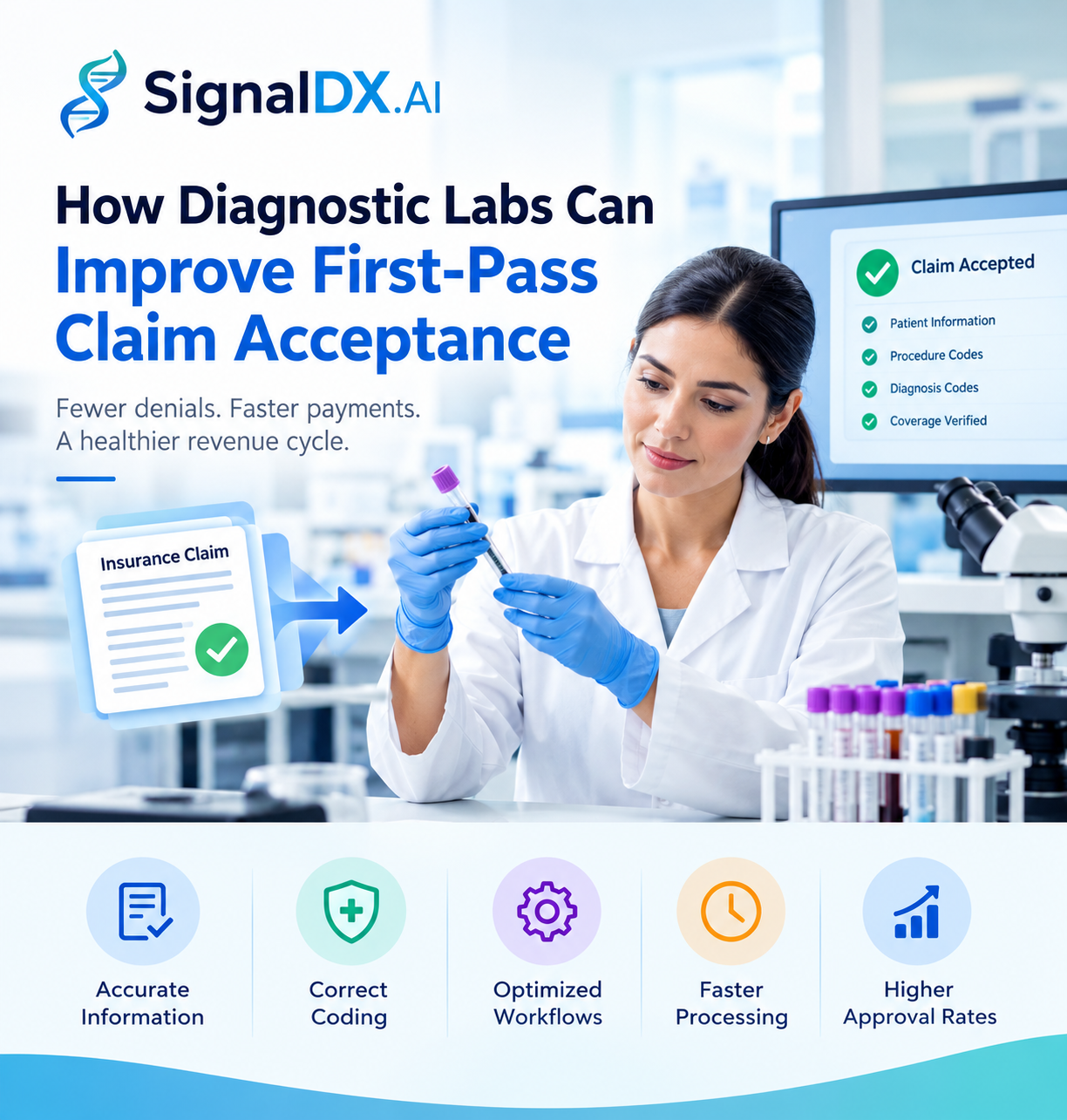
First-pass claim acceptance can make a major difference in how efficiently a diagnostic laboratory gets reimbursed. When claims move through the billing process correctly the first time, laboratories can reduce avoidable denials, limit manual rework, and improve payment timelines. SignalDX.AI helps diagnostic labs identify reimbursement risks before billing so teams can address problems earlier in the workflow.
For many laboratories, the real cause of a denied claim begins long before the claim reaches a payer. Missing patient information, incorrect insurance details, coding problems, medical necessity concerns, and payer-specific requirements can create problems downstream.
The solution is to catch those problems earlier.
Why First-Pass Claim Acceptance Matters
A denied or rejected claim creates more work for a laboratory.
Billing teams may have to investigate the problem, contact a provider, correct information, resubmit the claim, and monitor it again. When the same issues happen repeatedly, the workload can quickly increase.
Improving first-pass claim acceptance allows laboratories to focus on getting clean orders ready for billing rather than repeatedly correcting preventable problems.
A stronger process can help laboratories:
- Reduce preventable denials
- Improve clean claim performance
- Reduce billing rework
- Speed up reimbursement
- Improve staff productivity
- Identify recurring revenue cycle problems
The goal is simple: identify and correct problems before they become expensive downstream issues.
First-Pass Claim Acceptance Starts Before the Claim
One of the biggest mistakes in revenue cycle management is waiting until claim submission to look for problems.
By that point, an error may already have passed through several systems and teams.
A better approach is to review the order earlier.
Before an order moves toward billing, laboratories can check patient demographics, insurance information, provider details, diagnosis codes, test information, documentation, and payer requirements.
This creates a proactive process where potential problems are addressed while there is still time to correct them.
Verify Insurance Before Billing Problems Grow
Insurance eligibility is one of the areas where early verification can make a significant difference.
A patient’s coverage may be inactive. The member ID may be incorrect. Subscriber information may not match. The wrong payer may be selected, or important plan information may be missing.
If these problems are discovered only after claim submission, the billing team has additional work to complete.
SignalDX’s eligibility verification capabilities are designed to identify issues such as inactive coverage, subscriber mismatches, missing member information, incorrect payer details, and demographic mismatches earlier in the order workflow.
For diagnostic laboratories, checking eligibility earlier can help create cleaner orders before they reach billing.
Improve First-Pass Claim Acceptance With Accurate Coding
Coding problems can also affect claim acceptance.
Missing or invalid ICD-10 codes, CPT and test mismatches, incorrect modifiers, and other coding issues can create reimbursement problems.
A laboratory should therefore review coding information before an order becomes a claim.
The process should identify whether the diagnosis information supports the ordered service and whether the necessary billing information is present.
This is particularly important for laboratories handling complex or specialty testing, where payer requirements and medical necessity rules can vary.
SignalDX’s issue detection capabilities are designed to flag coding and billing concerns, including invalid ICD-10 codes, missing modifiers, CPT/test mismatches, and other order-level risks before claims are submitted.
Stop Payer Problems Before They Become Denials
Payer requirements can be difficult to manage because not every payer follows exactly the same rules.
Coverage policies, medical necessity requirements, documentation expectations, and other payer-specific conditions can affect whether a claim is reimbursed.
A laboratory that identifies these risks before submission has a better opportunity to resolve them.
SignalDX combines issue detection with payer policy intelligence to help diagnostic laboratories identify potential policy and medical necessity risks earlier in the workflow.
This changes the process from:
Claim submitted → Denial received → Problem investigated
to:
Order received → Risk identified → Problem corrected → Clean order moves forward
That difference can reduce unnecessary downstream work.
Use Pre-Claim Intelligence to Improve First-Pass Claim Acceptance
Traditional revenue cycle processes are often reactive.
The team submits the claim first and investigates the problem only after something goes wrong.
Pre-claim intelligence takes a different approach.
Instead of waiting for a denial, technology can analyze an order before billing and identify missing information, coding concerns, eligibility problems, documentation gaps, and payer-related risks.
SignalDX describes its platform as a pre-claim intelligence layer that analyzes diagnostic orders before billing and helps identify reimbursement risks before claims are submitted.
This gives laboratory teams an opportunity to resolve problems earlier.
Turn Claim Problems Into Actionable Workflows
Finding a problem is only the first step.
The next question is: Who needs to fix it?
A coding issue may need to go to a coding team. A missing document may require provider follow-up. An insurance problem may need to be reviewed by the eligibility team.
Without a structured workflow, these issues can sit in emails, spreadsheets, or disconnected systems.
SignalDX’s workflow automation is designed to route orders according to issue type, risk level, status, and required action. This helps teams identify who owns the next step and track the issue until resolution.
This creates a more organized process:
Detect → Assign → Correct → Review → Release
Reduce Manual Rework With Better Order Data
Poor data quality can create problems throughout the revenue cycle.
If information is entered incorrectly at intake, the error can move through multiple systems before someone discovers it.
AI-assisted intake and data normalization can help laboratories structure information earlier.
SignalDX’s platform can process information from sources such as faxed requisitions, scanned documents, HL7 messages, FHIR resources, APIs, and other order sources. The platform then structures information such as patient, provider, payer, diagnosis, CPT, and test details for downstream workflows.
Better data at intake can create a stronger foundation for billing.
Measure First-Pass Claim Acceptance
Improvement requires measurement.
Diagnostic laboratories should monitor the numbers that reveal where revenue cycle problems are occurring.
Important metrics can include:
- First-pass claim acceptance
- Clean claim rate
- Claim rejection rate
- Denial rate
- Eligibility-related denials
- Coding-related denials
- Corrected claim volume
- Average payment time
Tracking these metrics can help teams identify recurring problems.
For example, if eligibility-related denials remain high, the laboratory may need to improve the timing or quality of its insurance verification process.
If coding denials are increasing, the laboratory may need stronger coding review before billing.
First-Pass Claim Acceptance Requires Continuous Improvement
Improving claim acceptance is not a one-time project.
Payer requirements change. Testing services change. New workflows are introduced. Staff members change roles. New sources of order data are added.
Laboratories should regularly review denial trends and determine where problems originate.
The most valuable question is not simply:
“Why was this claim denied?”
It is:
“Where could we have caught this problem before the claim was submitted?”
That shift helps revenue cycle teams move from reactive denial management to proactive prevention.
How SignalDX Supports First-Pass Claim Acceptance
SignalDX is designed to help diagnostic laboratories identify reimbursement risks before claims are submitted.
Its platform brings together order intake, eligibility verification, issue detection, payer policy intelligence, workflow automation, and structured order processing. Clean orders can then move into existing laboratory and revenue cycle systems.
For laboratories looking to improve first-pass claim acceptance, this upstream approach can help address problems before they become denials.
Rather than waiting for a payer to identify an error, teams can work toward identifying and resolving potential problems earlier.
Conclusion
First-pass claim acceptance is an important part of a strong diagnostic laboratory revenue cycle.
The best way to improve it is not simply to work faster after denials occur. It is to prevent avoidable problems from reaching the claim stage in the first place.
Early eligibility verification, accurate coding, payer policy checks, better order data, automated workflows, and pre-claim intelligence can all contribute to a cleaner billing process.
For diagnostic laboratories, the opportunity is clear: catch problems earlier, fix them faster, and send cleaner orders downstream.