
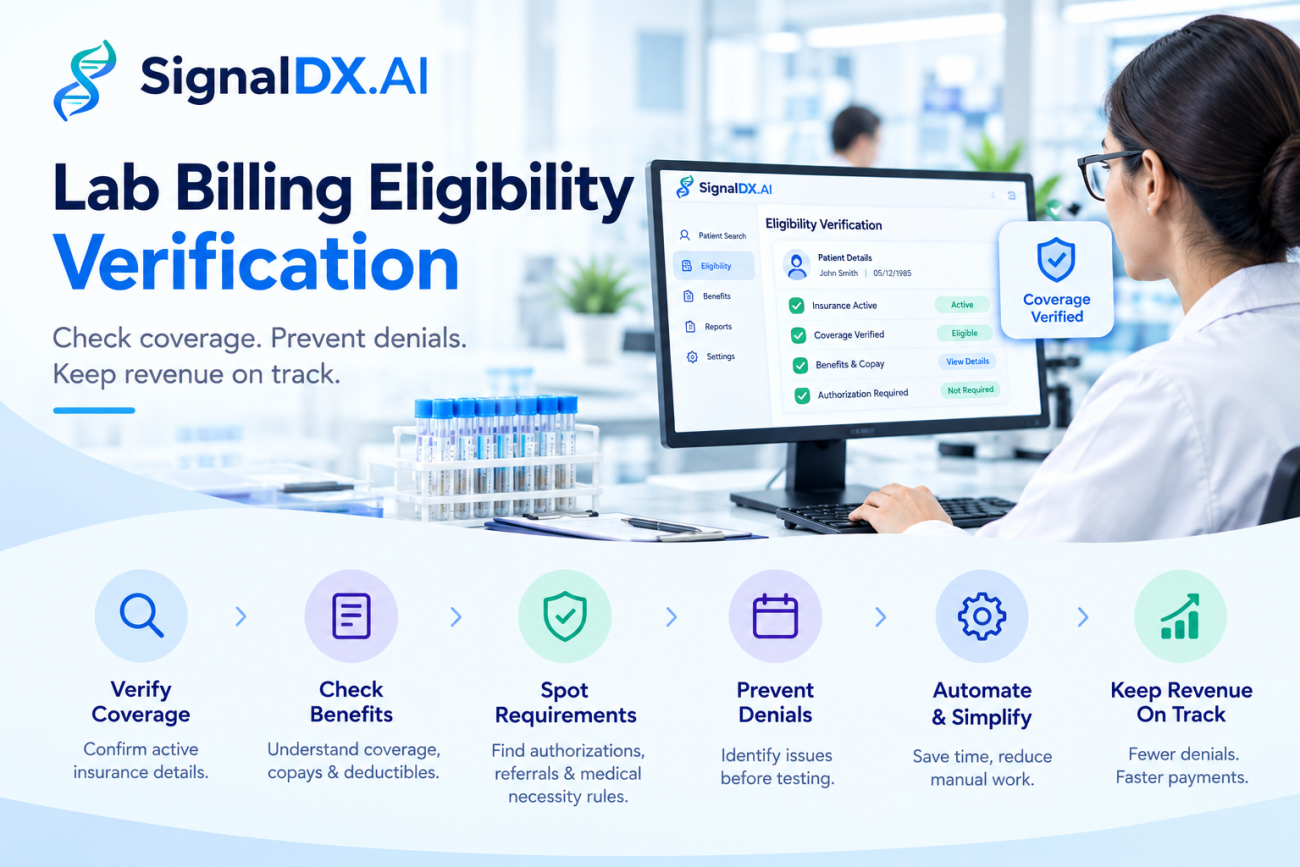
Lab billing eligibility verification is an important step in the laboratory revenue cycle. Before performing diagnostic testing, laboratories need to confirm that a patient’s insurance coverage is active and that the planned service is eligible for reimbursement. SignalDX.AI helps diagnostic laboratories identify opportunities to improve revenue cycle processes, reduce administrative work, and strengthen billing performance. Verifying coverage before testing gives billing teams an opportunity to identify incorrect insurance information, inactive policies, benefit limitations, and payer requirements before they result in claim problems.
Why Is Lab Billing Eligibility Important?
Lab billing eligibility helps laboratories determine whether a patient’s insurance can be used for the planned laboratory service. An insurance policy may be active, but that does not automatically mean every diagnostic test is covered.
Checking eligibility before testing can help laboratories identify potential issues early. This allows staff to request updated insurance information, review benefits, or determine whether additional requirements need to be met before the service is performed.
A consistent eligibility process can help laboratories:
- Confirm active insurance coverage
- Reduce avoidable claim denials
- Identify outdated patient information
- Understand potential patient responsibility
- Reduce billing rework
- Improve claim accuracy
- Support faster reimbursement
For laboratories processing a high volume of diagnostic tests, these improvements can have a meaningful effect on revenue cycle performance.
When Should Labs Verify Insurance Coverage?
The most effective time to verify insurance coverage is before the laboratory service is performed. Completing the verification early gives billing and registration teams time to resolve potential problems.
Eligibility should also be reviewed when a patient provides new insurance information or when existing coverage may have changed.
Labs should consider verifying coverage:
- Before scheduled laboratory testing
- When a new patient provides insurance information
- When an existing patient changes insurance plans
- Before recurring laboratory services
- Before expensive or specialized testing
- When previous claims have been denied for eligibility reasons
Verifying coverage at these points helps prevent laboratories from discovering insurance problems after services have already been completed.
What Information Should Be Verified Before Testing?
A complete lab billing eligibility check should involve more than confirming that an insurance policy is active. Billing teams should review the information needed to determine whether the laboratory service can be billed correctly.
Important information may include:
- Patient name and date of birth
- Insurance company
- Member ID
- Group number
- Subscriber information
- Policy effective date
- Policy termination date
- Laboratory benefits
- Deductible
- Copay
- Coinsurance
- Referral requirements
- Prior authorization requirements
- Medical-necessity requirements
Accurate documentation is also important. Keeping verification information available allows billing teams to reference the details if a claim is later questioned or denied.
How Does Eligibility Verification Prevent Claim Denials?
Claim denials can create additional work for laboratory billing teams. A denied claim may require staff to investigate the reason, correct information, contact the payer, resubmit the claim, and monitor the account again.
Insurance eligibility verification provides an opportunity to identify some of these issues before the claim reaches the payer.
For example, if a patient’s insurance coverage is inactive, the laboratory may be able to obtain updated insurance information before performing the service. If a particular test requires authorization, identifying that requirement early can give the laboratory time to address it.
This proactive approach can help reduce preventable eligibility-related denials and improve the overall laboratory billing process.
What Happens When Insurance Eligibility Is Not Verified?
Failing to verify eligibility before testing can create several downstream billing problems.
A laboratory may perform a service only to discover later that the patient’s coverage was inactive. In other situations, the payer may not cover the specific test, the patient’s information may be incorrect, or an authorization requirement may have been missed.
These issues can result in:
- Claim denials
- Delayed reimbursement
- Increased accounts receivable
- Additional staff workload
- Patient billing disputes
- Repeated claim submissions
The cost of correcting these problems can be greater than the time required to verify eligibility before testing.
How Can Labs Improve Their Eligibility Verification Process?
Laboratories can improve their eligibility process by establishing a consistent workflow that defines when coverage should be checked, what information should be reviewed, and how verification results should be documented.
A strong process should include clear responsibilities for registration, billing, and revenue cycle teams.
Labs can also improve the process by:
Standardizing Verification Procedures
Create a consistent checklist for the information that should be reviewed during each eligibility check.
Keeping Insurance Information Updated
Ask patients to provide updated insurance information whenever their coverage changes.
Documenting Verification Results
Record relevant coverage information so billing staff can refer back to it when needed.
Monitoring Eligibility-Related Denials
Review denial patterns to identify recurring problems with specific payers, plans, or patient information.
Using Automation
Technology can help reduce repetitive eligibility tasks and allow billing teams to focus on exceptions that require human review.
Can Eligibility Verification Be Automated?
Laboratories that process a large number of patients may find manual eligibility verification time-consuming. Staff may need to access multiple payer systems, enter patient information, review coverage details, and document results.
Automation can help streamline these repetitive activities. A technology-supported workflow can make it easier to organize eligibility information and identify cases that require additional attention.
SignalDX.AI can help laboratories identify opportunities to improve revenue cycle workflows and make billing operations more efficient. Automation should complement experienced billing professionals by reducing repetitive administrative work rather than replacing human review.
Best Practices for Lab Billing Eligibility
A reliable lab billing eligibility process should be proactive and consistent. Laboratories should make insurance verification part of their standard workflow rather than waiting until a claim is denied.
Key practices include:
- Verify coverage before testing whenever possible.
- Reverify coverage when insurance information changes.
- Check benefits, not just active status.
- Review authorization and referral requirements.
- Document eligibility results.
- Monitor eligibility-related denials.
- Keep patient information accurate and updated.
- Use automation to reduce repetitive administrative work.
These practices can help laboratories identify coverage issues earlier and reduce unnecessary billing rework.
Conclusion: Verify Coverage Before Testing
Lab billing eligibility verification is an important part of an efficient laboratory revenue cycle. Confirming insurance coverage before testing gives laboratories an opportunity to identify inactive policies, incorrect information, benefit limitations, and payer requirements before they become claim problems.
A proactive eligibility process can help reduce avoidable denials, improve billing accuracy, reduce administrative rework, and support more timely reimbursement. By combining standardized verification procedures with accurate documentation, denial monitoring, and appropriate automation, diagnostic laboratories can create a more reliable billing process.
Ultimately, verifying coverage before testing helps laboratories move from a reactive approach to a proactive revenue cycle strategy, allowing potential insurance issues to be addressed before they affect claims and payments.