
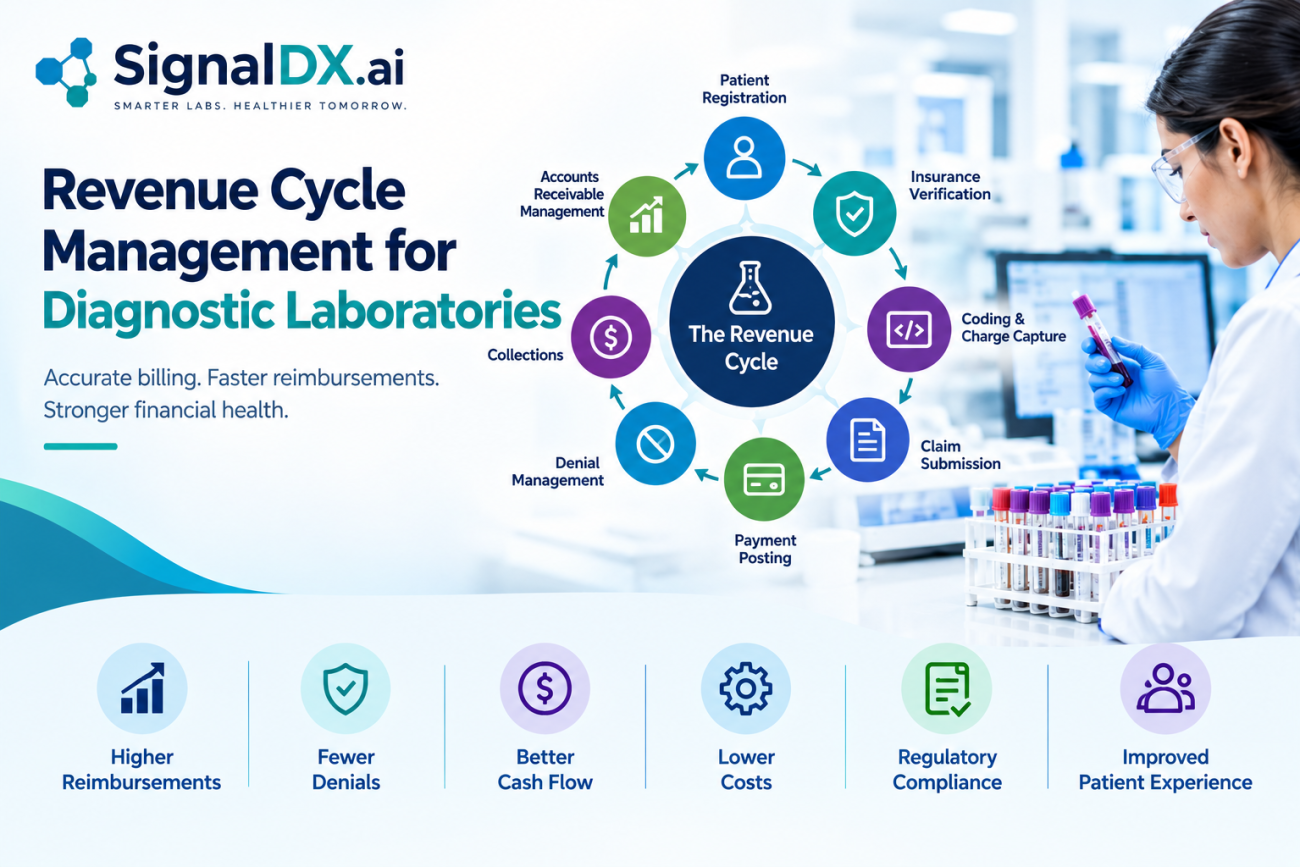
Revenue Cycle Management for Diagnostic Laboratories is essential for maintaining financial stability while ensuring accurate billing, timely reimbursements, and efficient administrative operations. At SignalDX.AI we understand the importance of streamlined revenue cycle processes for diagnostic laboratories that handle a high volume of tests, claims, insurance transactions, and patient payments every day. Even a small billing or coding error can result in claim denials, delayed payments, or lost revenue.
A well-managed laboratory revenue cycle connects every financial step, from patient registration and insurance verification to laboratory billing, claims submission, payment posting, denial management, and collections. By leveraging effective revenue cycle management strategies and technology, SignalDX.AI helps diagnostic laboratories improve cash flow, reduce administrative costs, minimize billing errors, and create a more efficient financial operation.
What Is Revenue Cycle Management for Diagnostic Laboratories?
Revenue Cycle Management (RCM) is the complete financial process used to manage healthcare services from the time a patient receives a service until the laboratory receives payment.
For diagnostic laboratories, RCM involves several interconnected activities, including:
- Patient and provider information management
- Insurance eligibility verification
- Test and service coding
- Charge capture
- Claim creation and submission
- Payment posting
- Denial management
- Accounts receivable management
- Patient billing and collections
Unlike many other healthcare providers, diagnostic laboratories often handle large numbers of tests and claims. This makes accuracy, automation, and timely follow-up particularly important.
Why Diagnostic Laboratory Revenue Cycle Management Matters
Diagnostic laboratories operate in an environment where reimbursement rules, insurance requirements, coding standards, and payer policies can be complex. Incorrect information can cause claims to be rejected or denied.
Effective diagnostic laboratory revenue cycle management helps laboratories identify problems before they affect cash flow.
A strong RCM process can help laboratories:
- Reduce claim denials and rejections.
- Accelerate insurance reimbursements.
- Improve accounts receivable performance.
- Reduce billing errors.
- Increase collections.
- Improve financial visibility.
- Reduce manual administrative work.
The goal is not simply to submit more claims. The goal is to submit clean, accurate claims that are processed and paid as quickly as possible.
Key Steps in Laboratory Revenue Cycle Management
1. Patient Registration and Data Collection
The revenue cycle begins with accurate patient and billing information. Demographic details, insurance information, referring provider information, and test details should be entered correctly.
Errors at registration can create problems later in the billing process. For example, an incorrect insurance ID or patient date of birth may result in a rejected claim.
Laboratories should therefore establish processes for verifying and updating patient information before claims are submitted.
2. Insurance Eligibility Verification
Insurance verification is another important part of Revenue Cycle Management for Diagnostic Laboratories.
Before performing or billing for services, laboratories should verify whether the patient’s insurance is active and determine applicable coverage requirements. Depending on the payer and service, authorization or other documentation may also be required.
Early verification can reduce unexpected billing issues and prevent avoidable claim denials.
3. Accurate Coding and Charge Capture
Correct coding is critical to laboratory reimbursement. Diagnostic tests must be properly represented on claims using the appropriate coding systems and billing information.
Coding errors can include incorrect codes, missing information, mismatched diagnosis and procedure information, or inaccurate modifiers.
Laboratories should implement regular coding audits and quality checks to identify recurring errors.
Laboratory Billing and Claims Management
Once services are coded and charges are captured, claims need to be prepared and submitted to the appropriate payer.
Laboratory billing services should focus on accuracy, completeness, and timely submission. Claims should be reviewed for missing information and potential errors before submission.
A clean-claim process can significantly reduce unnecessary delays.
Common Causes of Laboratory Claim Denials
Some common reasons for diagnostic laboratory claim denials include:
- Incorrect patient information
- Inactive insurance coverage
- Missing or incorrect codes
- Duplicate claims
- Missing authorization
- Incorrect payer information
- Medical necessity issues
- Timely filing violations
- Incorrect provider information
Identifying the root cause of denials is more effective than simply resubmitting rejected claims repeatedly.
Claim Denial Management for Diagnostic Laboratories
Lab claim denial management should be an ongoing process rather than a one-time activity.
When a claim is denied, the billing team should determine why the denial occurred, correct the underlying issue, and submit an appeal or corrected claim when appropriate.
Laboratories can categorize denials by reason and monitor trends over time. If a particular payer repeatedly denies claims for the same reason, the laboratory can investigate its internal workflow and make appropriate changes.
This approach turns denial data into an opportunity for process improvement.
Managing Laboratory Accounts Receivable
Laboratory accounts receivable represents money that is still owed to the laboratory. Monitoring outstanding balances is essential for maintaining healthy cash flow.
Accounts receivable teams should prioritize older and higher-value accounts while following up on unpaid claims within appropriate payer timelines.
Important metrics may include:
- Days in accounts receivable
- Claim denial rate
- Clean claim rate
- Collection rate
- First-pass payment rate
- Aging accounts receivable
- Average reimbursement time
Regular monitoring allows laboratory leaders to identify financial bottlenecks before they become major problems.
How Technology Improves Diagnostic Lab Billing
Technology and automation are increasingly important in modern diagnostic lab billing.
Automated systems can help identify missing information, track claims, monitor payment status, organize accounts receivable, and identify potential denial risks.
Automation can also reduce repetitive manual tasks, allowing billing teams to focus on complex accounts and exceptions.
For laboratories processing thousands of claims, even small improvements in automation can produce significant operational benefits.
Compliance and Data Accuracy in Laboratory RCM
Compliance should remain a central part of Revenue Cycle Management for Diagnostic Laboratories. Billing teams need to follow applicable healthcare regulations, payer requirements, coding standards, and documentation policies.
Accurate documentation supports appropriate reimbursement while reducing compliance risks.
Laboratories should also establish internal quality-control procedures, conduct regular audits, and provide ongoing training to billing and coding staff.
Benefits of Optimizing Revenue Cycle Management for Diagnostic Laboratories
An optimized laboratory revenue cycle can deliver both financial and operational benefits.
Improved Cash Flow
Faster claim processing and timely follow-up can help laboratories receive payments sooner.
Fewer Denials
Better data validation, coding accuracy, and eligibility verification can reduce preventable denials.
Lower Administrative Costs
Automation can minimize repetitive manual work and improve staff productivity.
Better Financial Visibility
RCM reporting provides laboratory leaders with insight into revenue, outstanding claims, payer performance, and collection trends.
Improved Patient Experience
Clearer billing processes and accurate information can reduce confusion for patients and referring providers.
Best Practices for Diagnostic Laboratory Revenue Cycle Management
To create an efficient laboratory revenue cycle, organizations should consider the following best practices:
- Verify insurance information early.
- Maintain accurate patient and provider data.
- Review claims before submission.
- Monitor payer-specific requirements.
- Track denial trends.
- Follow up on unpaid claims promptly.
- Analyze accounts receivable regularly.
- Automate repetitive billing processes where possible.
- Conduct regular coding and billing audits.
- Train staff on changing payer and billing requirements.
The Future of Laboratory Revenue Cycle Management
The future of diagnostic laboratory revenue cycle management will increasingly involve automation, analytics, artificial intelligence, and real-time financial monitoring.
Advanced RCM solutions can help identify potential claim problems before submission, predict payment behavior, prioritize accounts for follow-up, and provide better visibility into financial performance.
As diagnostic testing continues to grow, laboratories that invest in efficient revenue cycle processes will be better positioned to manage increasing claim volumes and reimbursement complexity.
Conclusion
Revenue Cycle Management for Diagnostic Laboratories is much more than billing. It is an integrated process that connects patient information, insurance verification, coding, claims, payments, denials, and collections.
By improving each stage of the revenue cycle, diagnostic laboratories can reduce preventable errors, accelerate reimbursement, strengthen cash flow, and improve operational efficiency.
A successful laboratory RCM strategy combines accurate data, effective billing processes, proactive denial management, technology, compliance, and continuous performance monitoring. For diagnostic laboratories looking to improve financial performance, optimizing the revenue cycle can be one of the most valuable operational investments they make.