
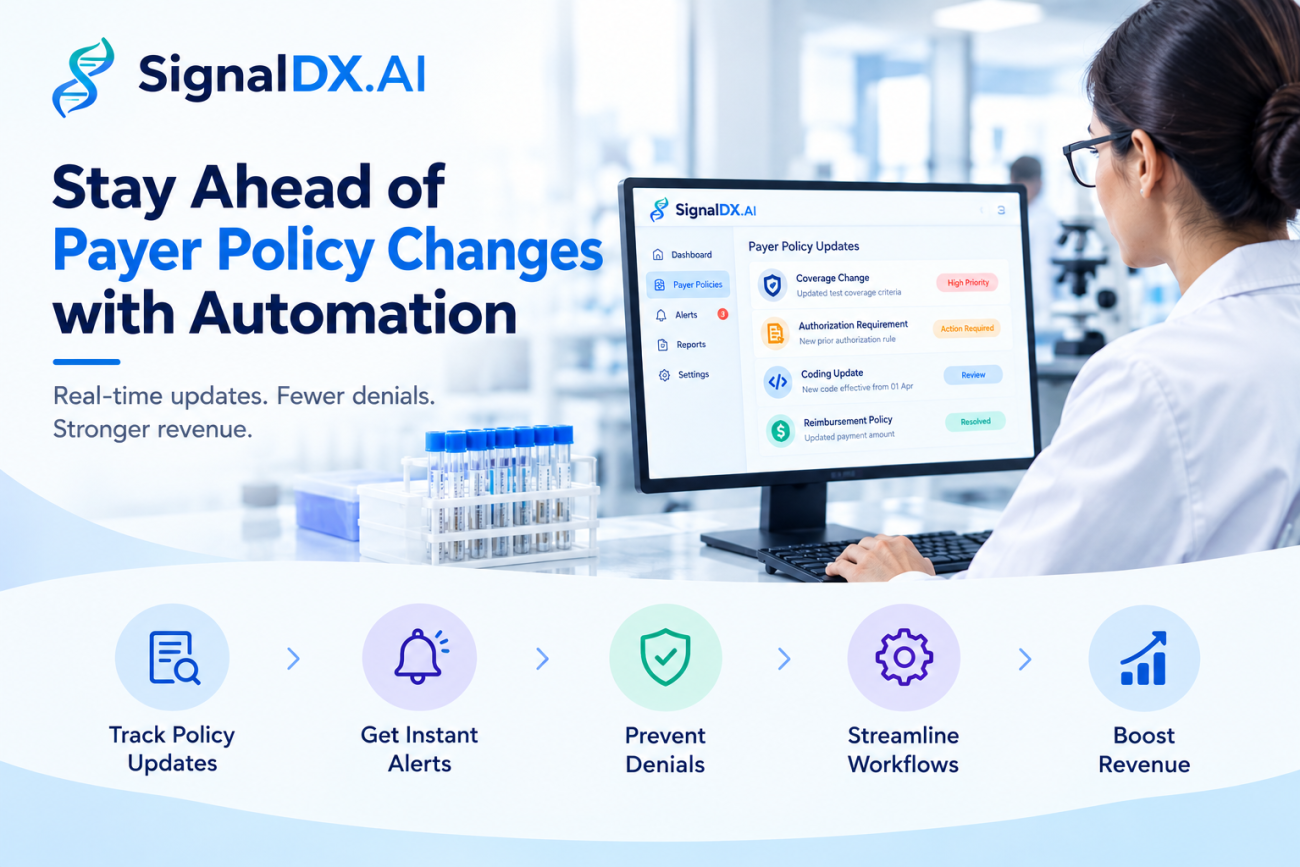
Payer policy monitoring can play an important role in helping diagnostic laboratories protect revenue and reduce avoidable billing problems. Insurance payers regularly change coverage rules, reimbursement policies, coding requirements, prior authorization rules, and medical necessity guidelines. When diagnostic labs miss these changes, claims can be delayed or denied, creating additional work and potential revenue loss. SignalDX.AI helps diagnostic laboratories explore smarter ways to manage revenue cycle operations and respond to changing payer requirements. By improving payer policy monitoring, labs can identify important changes earlier and take action before they negatively affect revenue.
Why Payer Policy Monitoring Matters for Diagnostic Labs
Diagnostic laboratories work with multiple insurance payers, and each payer can have different requirements for billing and reimbursement. Keeping up with these requirements becomes increasingly difficult as the number of payers, tests, and policies grows.
A policy change that appears minor can have a significant financial impact when it affects a frequently billed laboratory test. A change in coverage criteria, documentation requirements, or authorization rules can result in claims being rejected if the laboratory does not adjust its processes.
Effective payer policy monitoring gives revenue cycle teams better visibility into these changes. Instead of discovering a problem after claims have been denied, labs can identify relevant updates and review their potential financial impact in advance.
How Payer Policy Monitoring Can Unlock Better Revenue
Better revenue does not only come from increasing the number of claims a laboratory submits. It also comes from reducing avoidable revenue leakage throughout the billing process.
Payer policy monitoring can help diagnostic labs improve revenue by identifying changes that may affect:
- Claim acceptance and reimbursement
- Test coverage and medical necessity
- Prior authorization requirements
- Coding and documentation
- Payment policies and payer-specific rules
When these areas are monitored consistently, laboratories can make informed changes to their workflows before outdated processes affect large numbers of claims.
How Payer Policy Changes Can Cause Revenue Loss
Payer policies can change without a laboratory immediately realizing that an existing billing process is no longer appropriate. When that happens, claims may be submitted using outdated information.
For example, a payer could introduce a new authorization requirement for a specific diagnostic test. If the laboratory continues following its previous process, claims may be rejected because the required authorization was not obtained.
The laboratory then has to investigate the denial, determine what went wrong, correct the issue when possible, and potentially resubmit the claim. This creates additional administrative work while delaying payment.
Monitoring payer policies proactively can help labs identify these changes earlier and reduce the risk of repeated billing problems.
Using Payer Policy Monitoring to Reduce Claim Denials
Claim denials can directly affect laboratory revenue. Even when a claim can eventually be corrected and paid, the process requires additional staff time and can delay reimbursement.
Payer policy monitoring can support denial prevention by helping revenue cycle teams stay aware of changes that influence claim requirements.
For example, monitoring can help identify updates related to:
- Covered and non-covered laboratory services
- Medical necessity criteria
- Required documentation
- Coding requirements
- Prior authorization
- Payer-specific billing rules
When a relevant change is identified, the laboratory can review its current workflow and determine whether an update is necessary.
This proactive approach can be more effective than waiting for a denial report to reveal that a payer requirement has changed.
How Diagnostic Labs Can Monitor Payer Policies Automatically
Manual monitoring can require employees to regularly visit payer websites, review policy documents, compare updates, and determine which changes are relevant to the laboratory.
Automation can make this process more manageable.
An automated payer policy monitoring system can help track selected payer sources and identify new or modified information. Instead of requiring staff to manually search every source, technology can bring potentially relevant changes to their attention.
This allows revenue cycle professionals to spend more time reviewing the business impact of a policy change and less time searching for the information itself.
Automation should support human decision-making rather than replace it. Important payer updates should still be reviewed by qualified team members before operational changes are made.
Using AI to Improve Payer Policy Monitoring
Artificial intelligence can make policy monitoring even more useful by helping teams process large amounts of information.
AI can assist with comparing policy documents, identifying changes, summarizing important updates, and organizing information according to payer or service type.
For diagnostic laboratories, this can make it easier to answer important questions:
- What changed?
- Which payer made the change?
- When does the change take effect?
- Which tests or services are affected?
- Could the change affect claims or reimbursement?
- Does the laboratory need to update its workflow?
By turning large amounts of payer information into more manageable insights, AI can help revenue cycle teams respond more efficiently.
Payer Policy Monitoring for Prior Authorization
Prior authorization is one area where policy changes can create significant billing challenges.
A payer may change which tests require authorization or modify the documentation needed to receive approval. If laboratory staff are working from outdated requirements, the service may be performed without the necessary authorization.
Monitoring these changes can help diagnostic labs identify new requirements and communicate them to the appropriate teams.
The earlier a laboratory becomes aware of a relevant authorization change, the more opportunity it has to update its processes and reduce avoidable claim problems.
Monitoring Medical Necessity Requirements
Medical necessity policies can also influence whether diagnostic services are reimbursed.
Payers may update the conditions, diagnoses, documentation, or other requirements associated with specific tests. These changes can affect whether a claim meets the payer’s current criteria.
Regular payer policy monitoring allows laboratories to identify these updates and evaluate their potential impact on billing and documentation.
This can help revenue cycle teams work more proactively instead of discovering problems after reimbursement has already been affected.
How Payer Policy Monitoring Protects Lab Revenue
Revenue protection requires more than identifying denials after they happen. Diagnostic laboratories need processes that help prevent avoidable billing issues before claims are submitted.
Payer policy monitoring can become part of that preventive strategy.
When a relevant policy update is detected, the laboratory can review its current billing procedures, determine whether the change affects specific tests, and update internal instructions when necessary.
This can help reduce repeated errors and prevent outdated payer information from being used across large numbers of claims.
The result is a revenue cycle process that is more responsive to payer changes.
Turning Payer Data Into Better Revenue Decisions
Collecting payer information is only useful when the information leads to action.
Diagnostic labs can organize policy updates by payer, test, service, effective date, and type of requirement. This makes it easier for revenue cycle teams to understand which changes deserve immediate attention.
For example, a policy update affecting a high-volume test may deserve greater priority than a change affecting a service that the laboratory rarely performs.
This type of prioritization can help teams focus their resources where the potential financial impact is greatest.
Creating a Proactive Payer Monitoring Workflow
A strong payer policy monitoring process should connect policy information with revenue cycle action.
A diagnostic laboratory can create a workflow that includes:
- Monitor relevant payer policies and updates.
- Identify new or modified requirements.
- Determine which laboratory services are affected.
- Review the potential revenue and claim impact.
- Update billing, coding, authorization, or documentation processes.
- Communicate the change to the appropriate teams.
- Monitor claims to determine whether the change is producing new issues.
This creates a continuous process instead of treating payer policy research as a one-time administrative task.
The Role of Technology in Better Revenue Cycle Management
Technology can help diagnostic laboratories manage payer information more efficiently, but technology alone does not create better revenue.
The real value comes from connecting information with action.
When automated monitoring identifies an important policy change, revenue cycle teams need a clear process for reviewing it and determining what should change. When those steps work together, laboratories can move from reactive denial management toward proactive revenue protection.
Solutions such as SignalDX.AI can support laboratories as they explore technology-driven approaches to improving revenue cycle visibility and efficiency.
Conclusion
Payer policy monitoring can help diagnostic laboratories take a more proactive approach to revenue protection. By identifying changes in coverage, authorization, medical necessity, coding, documentation, and reimbursement policies, labs can respond before outdated requirements create widespread billing problems.
The biggest opportunity is not simply to monitor more payer information. It is to turn that information into better decisions. When diagnostic labs combine automated monitoring, AI-supported analysis, human review, and clear revenue cycle workflows, they can reduce avoidable claim problems and improve the efficiency of their billing operations.
For diagnostic laboratories, better payer policy monitoring can mean better visibility, fewer surprises, less administrative rework, and a stronger opportunity to protect and improve revenue.