
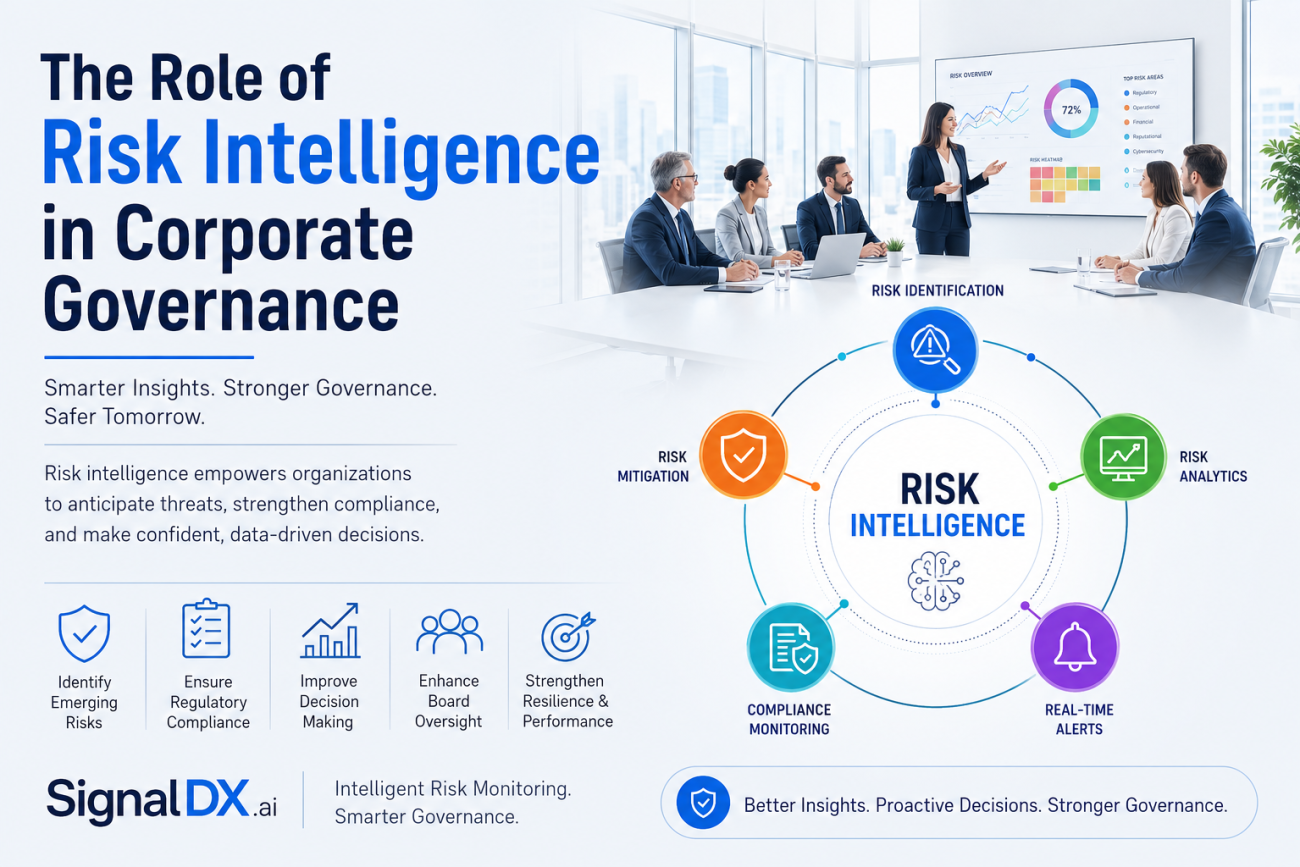
The Role of Risk Intelligence in Corporate Governance
In today’s rapidly evolving business environment, The Role of Risk Intelligence in Corporate Governance has become more important than ever. Organizations face increasing regulatory requirements, cyber threats, supply chain disruptions, financial uncertainties, and reputational risks. Traditional governance models that rely on periodic reporting are no longer sufficient. Modern enterprises need continuous, data-driven insights to identify risks before they escalate into costly problems. Risk intelligence empowers boards, executives, and compliance teams to make informed decisions based on real-time information rather than assumptions. Platforms like SignalDX.ai help organizations strengthen governance by transforming complex risk data into actionable intelligence, enabling proactive oversight and better strategic decision-making.
Corporate governance is fundamentally about accountability, transparency, and protecting stakeholder interests. Risk intelligence strengthens each of these areas by helping organizations detect emerging threats, monitor compliance obligations, and respond quickly to changing business conditions.
What Is Risk Intelligence in Corporate Governance?
Risk intelligence is the ability to collect, analyze, monitor, and interpret internal and external risk information to support smarter business decisions. Instead of reacting after problems occur, organizations use advanced analytics and artificial intelligence to anticipate potential risks and mitigate them before they impact operations.
Within corporate governance, risk intelligence supports executives and board members by providing accurate, timely, and relevant insights across multiple business functions. These insights help organizations maintain regulatory compliance, improve operational resilience, protect brand reputation, and enhance long-term sustainability.
Unlike traditional risk management, which often depends on manual reviews and periodic assessments, modern risk intelligence continuously evaluates changing conditions to identify new threats in real time.
Why The Role of Risk Intelligence in Corporate Governance Matters
Corporate boards are expected to oversee risk management more effectively than ever before. Investors, regulators, customers, and employees all expect organizations to demonstrate responsible governance and sound decision-making.
Risk intelligence provides organizations with greater visibility into operational, financial, regulatory, cybersecurity, and third-party risks. Rather than relying solely on historical reports, leadership teams gain access to live risk indicators that support faster and more confident decisions.
Organizations with mature risk intelligence capabilities are better positioned to respond to unexpected events while maintaining compliance and business continuity.
How Risk Intelligence Strengthens Corporate Governance
Better Strategic Decision-Making
Every strategic decision carries some level of uncertainty. Whether entering a new market, acquiring another company, or launching new products, leadership teams must understand the associated risks.
Risk intelligence combines historical trends, predictive analytics, and external market signals to provide executives with a comprehensive understanding of potential challenges before major decisions are made.
This results in more confident planning and fewer costly surprises.
Improved Regulatory Compliance
Regulatory environments continue to evolve across industries. Compliance failures can lead to financial penalties, operational disruptions, and reputational damage.
Risk intelligence helps organizations monitor changing regulations while identifying potential compliance gaps early. Automated monitoring reduces manual workloads and enables compliance teams to respond proactively rather than reactively.
With AI-powered solutions like SignalDX.ai, businesses can continuously monitor regulatory developments and receive alerts before issues become significant compliance risks.
Enhanced Board Oversight
Corporate boards require accurate information to fulfill their governance responsibilities.
Risk intelligence provides executive dashboards that summarize enterprise-wide risks in a clear and actionable format. Instead of reviewing fragmented reports from different departments, directors gain a unified view of organizational risk.
This improves board discussions, supports evidence-based governance, and strengthens accountability across the organization.
Risk Intelligence Improves Enterprise Risk Management
Enterprise Risk Management (ERM) depends on identifying, assessing, and responding to risks across every business function.
Risk intelligence enhances ERM by integrating data from multiple sources, including:
- Financial systems
- Operational processes
- Cybersecurity monitoring
- Third-party suppliers
- Regulatory databases
- News and adverse media
- Internal compliance systems
This comprehensive visibility enables organizations to prioritize risks based on likelihood and potential impact.
Instead of managing risks independently within departments, organizations develop a coordinated enterprise-wide approach.
AI and Risk Intelligence Are Transforming Governance
Artificial Intelligence has significantly improved modern governance programs.
AI-powered risk intelligence platforms automate large portions of the risk management process, including data collection, anomaly detection, trend analysis, and continuous monitoring.
Machine learning models identify patterns that would be difficult for human analysts to recognize manually.
These capabilities enable organizations to:
- Detect emerging risks earlier
- Reduce manual investigations
- Improve reporting accuracy
- Accelerate compliance monitoring
- Strengthen executive decision-making
- Improve audit readiness
As organizations continue generating larger volumes of data, AI becomes essential for maintaining effective governance.
The Role of SignalDX.ai in Corporate Governance
SignalDX.ai helps organizations strengthen corporate governance through intelligent risk monitoring and AI-driven analytics.
Instead of relying on disconnected spreadsheets and manual reporting processes, organizations gain a centralized platform for monitoring operational, regulatory, and reputational risks.
SignalDX.ai provides continuous visibility into changing risk conditions while helping compliance teams identify emerging threats before they become major business issues.
Key capabilities include intelligent risk monitoring, automated compliance insights, adverse media monitoring, predictive analytics, executive dashboards, and real-time alerts.
These capabilities enable organizations to create a proactive governance framework that supports faster and more informed executive decisions.
Benefits of Risk Intelligence for Corporate Governance
Organizations implementing advanced risk intelligence solutions experience measurable improvements across governance functions.
They gain greater transparency throughout the organization because executives receive consistent, real-time visibility into business risks. Decision-making improves because leadership teams rely on accurate data instead of assumptions. Compliance becomes more efficient through continuous monitoring and early detection of regulatory changes.
Risk intelligence also strengthens operational resilience by identifying disruptions before they affect business performance. Enhanced reporting capabilities improve communication with boards, regulators, and stakeholders, while predictive analytics help organizations prepare for future risks rather than simply reacting to current challenges.
Collectively, these benefits contribute to stronger governance, greater stakeholder confidence, and more sustainable long-term growth.
Building a Risk Intelligence Strategy
Successful organizations treat risk intelligence as an ongoing governance capability rather than a one-time project.
An effective strategy begins by identifying critical business risks and establishing clear governance objectives. Organizations should integrate data across departments, automate monitoring wherever possible, and implement AI-powered analytics to detect emerging threats.
Executive dashboards should present meaningful risk indicators that support timely decision-making, while governance teams should continuously review risk models to ensure they remain aligned with changing business conditions.
Regular training and collaboration between risk, compliance, legal, finance, and executive leadership further strengthen governance effectiveness.
Future Trends in Risk Intelligence and Corporate Governance
Corporate governance will continue evolving as organizations adopt increasingly sophisticated technologies.
Artificial intelligence, predictive analytics, automation, and real-time monitoring will become standard components of governance programs. Boards will increasingly rely on live risk dashboards rather than quarterly reports, allowing for faster responses to changing market conditions.
Environmental, Social, and Governance (ESG) reporting will also place greater emphasis on integrated risk intelligence, requiring organizations to monitor financial, operational, regulatory, and sustainability risks together.
Organizations that invest early in intelligent governance technologies will gain stronger resilience, better compliance outcomes, and greater competitive advantage.
Conclusion
The Role of Risk Intelligence in Corporate Governance continues to grow as organizations navigate increasingly complex business environments. Effective governance depends on accurate information, continuous monitoring, and proactive decision-making. Risk intelligence enables boards and executives to identify threats earlier, improve compliance, strengthen operational resilience, and make smarter strategic decisions.
AI-powered platforms like SignalDX.ai help organizations modernize governance by transforming fragmented risk data into actionable insights. By adopting intelligent risk monitoring and predictive analytics, businesses can build stronger governance frameworks, reduce uncertainty, and confidently prepare for future challenges.