
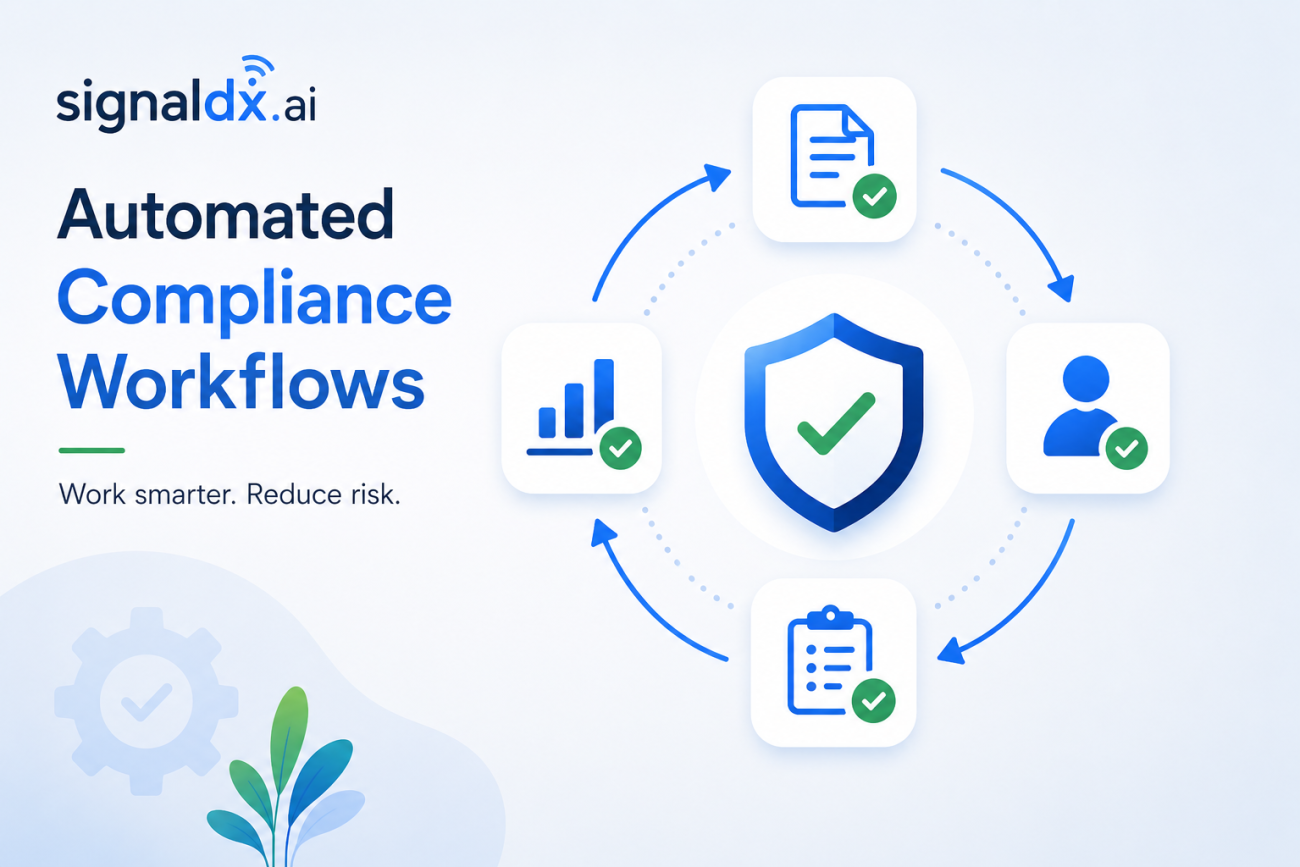
The Benefits of Automated Compliance Workflows
Organizations today operate in an increasingly complex regulatory environment where compliance requirements continue to grow across industries. The Benefits of Automated Compliance Workflows have become impossible to ignore as businesses seek faster, more accurate, and cost-effective ways to meet regulatory obligations. Manual compliance processes consume valuable time, increase operational costs, and expose organizations to unnecessary risks. By automating compliance workflows, businesses can improve efficiency, strengthen governance, minimize errors, and respond quickly to changing regulations. Platforms like SignalDX.ai help organizations modernize compliance operations with intelligent automation, AI-powered monitoring, and real-time risk visibility.
Why Compliance Is Becoming More Complex
Modern organizations must comply with numerous regulations, including industry-specific standards, cybersecurity requirements, privacy laws, environmental regulations, financial reporting rules, and internal governance policies. Regulatory expectations continue to evolve, making manual compliance management increasingly difficult.
Compliance teams often spend countless hours reviewing documents, collecting evidence, updating spreadsheets, conducting audits, and preparing reports. These repetitive activities reduce productivity while increasing the possibility of mistakes.
As organizations grow, the number of departments, vendors, business units, and regulatory obligations also expands. Without automation, maintaining consistent compliance becomes extremely challenging.
This is where The Benefits of Automated Compliance Workflows become especially valuable.
What Are Automated Compliance Workflows?
Automated compliance workflows use software, artificial intelligence, and intelligent business rules to manage compliance activities with minimal manual intervention. Instead of relying on spreadsheets, emails, and disconnected systems, automated workflows centralize compliance tasks into a single platform.
These workflows automatically collect evidence, assign responsibilities, monitor deadlines, trigger alerts, generate reports, document activities, and maintain complete audit trails.
SignalDX.ai helps organizations transform traditional compliance management into an intelligent, proactive system capable of identifying risks before they become compliance failures.
The Benefits of Automated Compliance Workflows for Modern Businesses
Organizations across healthcare, finance, manufacturing, insurance, government, and technology are investing in automation because of the significant advantages it delivers.
The Benefits of Automated Compliance Workflows Improve Accuracy
Human error remains one of the largest causes of compliance violations.
Manual data entry, forgotten deadlines, inconsistent documentation, and incomplete reporting often lead to audit findings and regulatory penalties.
Automated compliance workflows standardize every process. Information is collected consistently, approvals follow predefined paths, documentation remains complete, and compliance evidence is stored automatically.
By removing repetitive manual work, organizations dramatically improve accuracy while reducing costly mistakes.
Automated Compliance Workflows Reduce Compliance Risks
Compliance failures rarely occur because organizations intentionally ignore regulations. Most violations result from missed tasks, delayed reviews, outdated policies, or incomplete monitoring.
Automation continuously monitors compliance activities and immediately alerts responsible teams when something requires attention.
SignalDX.ai enables organizations to identify compliance gaps early through intelligent monitoring, allowing corrective action before regulators discover issues.
This proactive approach significantly reduces organizational risk.
Faster Regulatory Response Through Automated Compliance Workflows
Regulations evolve constantly.
Organizations using manual compliance systems often struggle to update policies, procedures, documentation, and employee responsibilities quickly enough.
Automated workflows simplify regulatory updates by automatically distributing new requirements, assigning review tasks, notifying stakeholders, and tracking implementation progress.
Instead of spending weeks updating compliance documentation, organizations can respond within hours.
Better Visibility Across Compliance Operations
Executives need complete visibility into compliance performance.
Traditional compliance programs rely on manual reporting, making it difficult to understand organizational risk in real time.
Automated dashboards provide continuous insight into:
Compliance status
Outstanding tasks
Policy reviews
Audit readiness
Risk indicators
Control effectiveness
Training completion
SignalDX.ai consolidates these metrics into executive dashboards that support informed decision-making.
How AI Enhances Automated Compliance Workflows
Artificial intelligence takes automation beyond simple task management.
Instead of only automating repetitive work, AI identifies trends, predicts risks, analyzes regulatory changes, and recommends corrective actions.
AI-powered compliance solutions can automatically detect unusual activity, identify policy violations, recognize emerging risks, and prioritize the most critical issues.
SignalDX.ai combines AI with intelligent workflow automation to provide organizations with proactive compliance management instead of reactive reporting.
Automated Compliance Workflows Strengthen Audit Readiness
Preparing for audits often requires weeks of collecting documentation from multiple departments.
Employees search through emails, spreadsheets, shared folders, and paper files to gather evidence requested by auditors.
Automated workflows continuously collect compliance documentation throughout the year.
Every approval, policy update, review, assessment, and corrective action is automatically recorded with timestamps and audit trails.
As a result, organizations remain audit-ready every day instead of scrambling before inspections.
Improved Collaboration Across Departments
Compliance is rarely the responsibility of a single team.
Legal departments, HR, finance, cybersecurity, operations, procurement, and executive leadership all contribute to organizational compliance.
Automated workflows assign tasks to the appropriate stakeholders while providing complete visibility into progress.
Notifications, reminders, approvals, escalations, and documentation occur automatically, reducing communication delays and improving accountability.
Everyone understands their responsibilities without relying on endless email chains.
The Benefits of Automated Compliance Workflows Reduce Operational Costs
Manual compliance programs require significant labor.
Employees spend hours entering information, updating reports, scheduling reviews, and verifying documentation.
Automation eliminates repetitive administrative work, allowing compliance professionals to focus on strategy, risk analysis, and continuous improvement.
Reduced manual effort also lowers operational expenses while improving overall productivity.
Organizations achieve more with existing resources.
Stronger Policy Management
Policies constantly evolve as regulations change.
Without automation, organizations often struggle to ensure employees are reviewing and acknowledging updated policies.
Automated compliance workflows distribute policy updates automatically, request employee acknowledgments, monitor completion rates, and generate compliance records.
This creates consistent policy governance across the organization.
Real-Time Monitoring Improves Compliance Performance
Traditional compliance reviews happen periodically.
Unfortunately, risks often emerge between scheduled assessments.
Real-time monitoring continuously evaluates organizational activities, vendor behavior, operational data, regulatory changes, and compliance indicators.
SignalDX.ai provides continuous monitoring that enables organizations to detect problems immediately instead of waiting for quarterly reviews.
Continuous visibility leads to faster corrective actions and improved compliance performance.
Automated Compliance Workflows Support Business Growth
Growing organizations often expand into new markets, acquire companies, onboard suppliers, or launch new services.
Each expansion introduces additional regulatory obligations.
Manual compliance processes struggle to scale with business growth.
Automated workflows easily adapt to increased workloads without requiring proportional increases in staffing.
Whether an organization manages hundreds or thousands of compliance activities, automation maintains consistency and efficiency.
Better Risk Management Through Intelligent Automation
Compliance and risk management work together.
Organizations that automate compliance also strengthen enterprise risk management.
AI-powered systems identify patterns that may indicate operational weaknesses, control failures, vendor risks, cybersecurity threats, or regulatory concerns.
SignalDX.ai integrates compliance automation with intelligent risk detection, giving leadership greater confidence in organizational resilience.
Enhanced Vendor and Third-Party Compliance
Many compliance failures originate outside the organization.
Suppliers, contractors, vendors, and business partners introduce additional regulatory risks.
Automated workflows continuously monitor third-party documentation, certifications, contracts, insurance records, and regulatory obligations.
Automatic reminders ensure vendors maintain compliance while reducing administrative effort for internal teams.
The Benefits of Automated Compliance Workflows Improve Decision-Making
Compliance leaders need reliable data to make informed decisions.
Automated systems generate accurate reports using real-time information instead of manually compiled spreadsheets.
Executives gain visibility into compliance trends, audit findings, unresolved issues, regulatory changes, and organizational performance.
Better information leads to stronger governance and smarter business decisions.
Employee Productivity Increases
Employees become frustrated when repetitive administrative tasks consume valuable working hours.
Automation eliminates manual reminders, repetitive approvals, duplicate documentation, and unnecessary paperwork.
Compliance professionals can focus on higher-value responsibilities such as regulatory strategy, process improvement, investigations, and risk mitigation.
This increases job satisfaction while improving organizational performance.
Why SignalDX.ai Is an Ideal Compliance Automation Platform
SignalDX.ai combines artificial intelligence, workflow automation, continuous monitoring, and predictive analytics into one intelligent platform.
Organizations can automate compliance monitoring, identify emerging risks, generate executive dashboards, maintain complete audit trails, and respond faster to changing regulations.
Instead of reacting after compliance failures occur, SignalDX.ai helps businesses anticipate risks and maintain continuous compliance.
Its intelligent automation capabilities simplify complex regulatory environments while improving efficiency across every department.
Future Trends in Automated Compliance Workflows
Compliance technology continues to evolve rapidly.
Artificial intelligence will increasingly predict regulatory risks before violations occur. Machine learning will identify compliance patterns that humans cannot easily detect. Intelligent automation will connect compliance data across departments, vendors, cybersecurity systems, financial platforms, and operational processes.
Organizations adopting these innovations today will remain better prepared for tomorrow’s regulatory landscape.
SignalDX.ai continues to help businesses embrace these advancements through intelligent compliance automation and AI-powered risk intelligence.
Conclusion
The Benefits of Automated Compliance Workflows extend far beyond reducing paperwork. Automation improves accuracy, strengthens governance, enhances audit readiness, reduces operational costs, supports business growth, increases productivity, and enables proactive risk management.
As regulations become more demanding, organizations can no longer rely on manual compliance processes. Intelligent platforms like SignalDX.ai empower businesses to streamline compliance, detect emerging risks in real time, and maintain continuous regulatory readiness.
Organizations that invest in automated compliance workflows today position themselves for greater operational resilience, stronger regulatory confidence, and sustainable long-term success.