The Role of Risk Intelligence in Corporate Governance
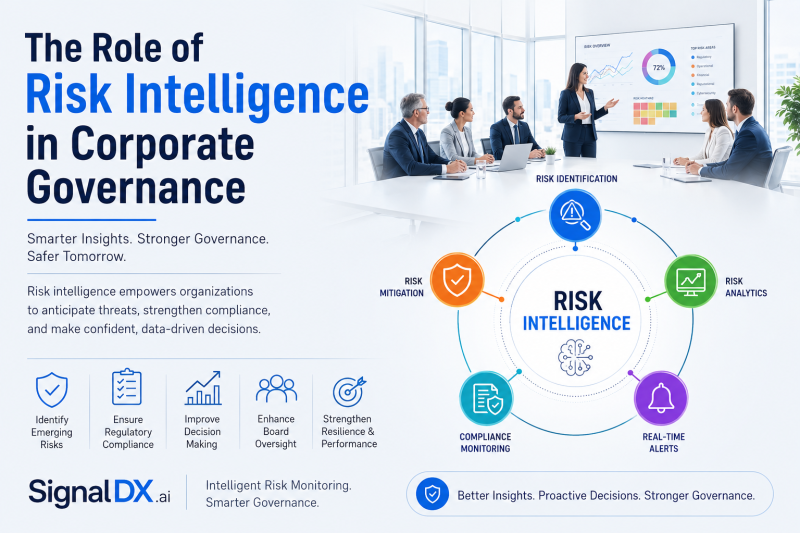
In today’s rapidly evolving business environment, The Role of Risk Intelligence in Corporate Governance has become more important than ever. Organizations face increasing regulatory requirements, cyber threats, supply chain disruptions, financial uncertainties, and reputational risks. Traditional governance models that rely on periodic reporting are no longer sufficient. Modern enterprises need continuous, data-driven insights to identify risks before they escalate into costly problems. Risk intelligence empowers boards, executives, and compliance teams to make informed decisions based on real-time information rather than assumptions. Platforms like SignalDX.aihelp organizations strengthen governance by transforming complex risk data into actionable intelligence, enabling proactive oversight and better strategic decision-making.
Corporate governance is fundamentally about accountability, transparency, and protecting stakeholder interests. Risk intelligence strengthens each of these areas by helping organizations detect emerging threats, monitor compliance obligations, and respond quickly to changing business conditions.
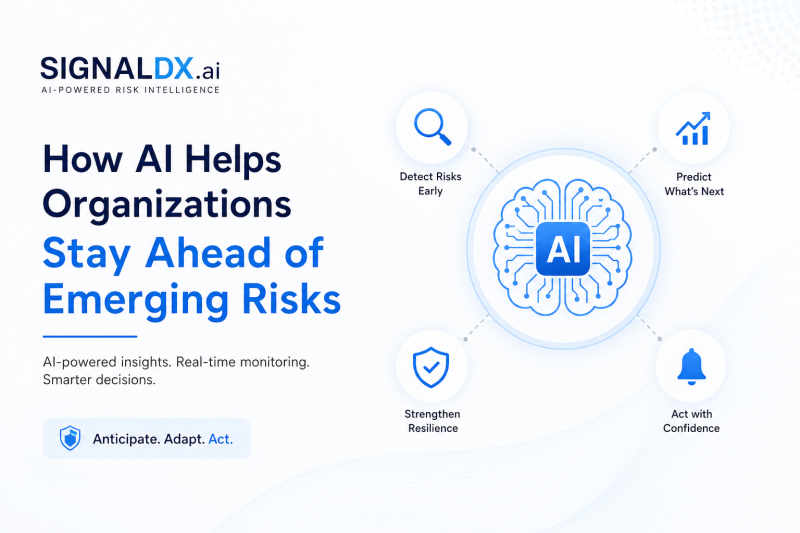
In today’s fast-changing business environment, How AI Helps Organizations Stay Ahead of Emerging Risks has become a critical topic for executives, compliance teams, and risk professionals. Organizations face increasing threats from cyberattacks, regulatory changes, financial crime, supply chain disruptions, geopolitical events, and reputational damage. Traditional risk management methods often struggle to detect these issues early enough. Artificial intelligence (AI) is transforming how organizations identify, monitor, and respond to emerging risks by analyzing massive volumes of data in real time. Platforms like SignalDX.ai empower businesses with intelligent risk monitoring, predictive analytics, and automated alerts that enable faster, smarter decisions while reducing operational and compliance risks.
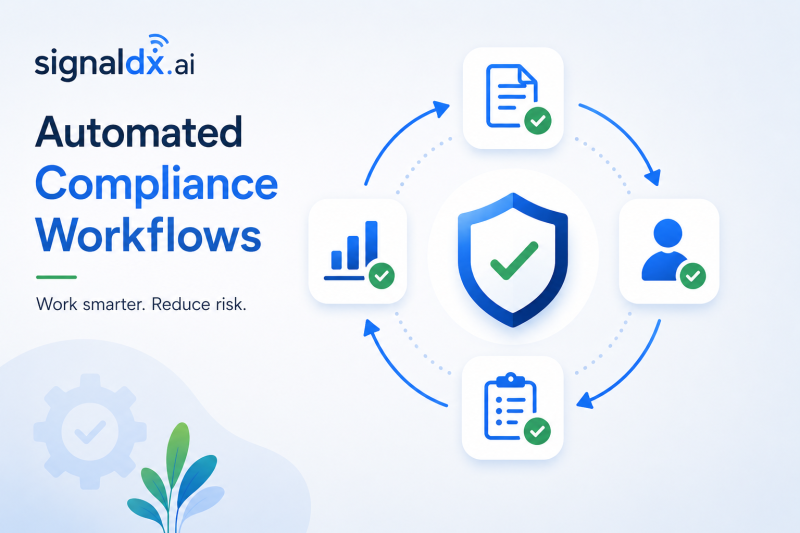
Organizations today operate in an increasingly complex regulatory environment where compliance requirements continue to grow across industries. The Benefits of Automated Compliance Workflows have become impossible to ignore as businesses seek faster, more accurate, and cost-effective ways to meet regulatory obligations. Manual compliance processes consume valuable time, increase operational costs, and expose organizations to unnecessary risks. By automating compliance workflows, businesses can improve efficiency, strengthen governance, minimize errors, and respond quickly to changing regulations. Platforms like SignalDX.ai help organizations modernize compliance operations with intelligent automation, AI-powered monitoring, and real-time risk visibility.
Why Compliance Is Becoming More Complex
Modern organizations must comply with numerous regulations, including industry-specific standards, cybersecurity requirements, privacy laws, environmental regulations, financial reporting rules, and internal governance policies. Regulatory expectations continue to evolve, making manual compliance management increasingly difficult.
Compliance teams often spend countless hours reviewing documents, collecting evidence, updating spreadsheets, conducting audits, and preparing reports. These repetitive activities reduce productivity while increasing the possibility of mistakes.
As organizations grow, the number of departments, vendors, business units, and regulatory obligations also expands. Without automation, maintaining consistent compliance becomes extremely challenging.
This is where The Benefits of Automated Compliance Workflows become especially valuable.
What Are Automated Compliance Workflows?
Automated compliance workflows use software, artificial intelligence, and intelligent business rules to manage compliance activities with minimal manual intervention. Instead of relying on spreadsheets, emails, and disconnected systems, automated workflows centralize compliance tasks into a single platform.
These workflows automatically collect evidence, assign responsibilities, monitor deadlines, trigger alerts, generate reports, document activities, and maintain complete audit trails.
SignalDX.ai helps organizations transform traditional compliance management into an intelligent, proactive system capable of identifying risks before they become compliance failures.
The Benefits of Automated Compliance Workflows for Modern Businesses
Organizations across healthcare, finance, manufacturing, insurance, government, and technology are investing in automation because of the significant advantages it delivers.
The Benefits of Automated Compliance Workflows Improve Accuracy
Human error remains one of the largest causes of compliance violations.
Manual data entry, forgotten deadlines, inconsistent documentation, and incomplete reporting often lead to audit findings and regulatory penalties.
Automated compliance workflows standardize every process. Information is collected consistently, approvals follow predefined paths, documentation remains complete, and compliance evidence is stored automatically.
By removing repetitive manual work, organizations dramatically improve accuracy while reducing costly mistakes.
Compliance failures rarely occur because organizations intentionally ignore regulations. Most violations result from missed tasks, delayed reviews, outdated policies, or incomplete monitoring.
Automation continuously monitors compliance activities and immediately alerts responsible teams when something requires attention.
SignalDX.ai enables organizations to identify compliance gaps early through intelligent monitoring, allowing corrective action before regulators discover issues.
This proactive approach significantly reduces organizational risk.
Faster Regulatory Response Through Automated Compliance Workflows
Regulations evolve constantly.
Organizations using manual compliance systems often struggle to update policies, procedures, documentation, and employee responsibilities quickly enough.
Automated workflows simplify regulatory updates by automatically distributing new requirements, assigning review tasks, notifying stakeholders, and tracking implementation progress.
Instead of spending weeks updating compliance documentation, organizations can respond within hours.
Better Visibility Across Compliance Operations
Executives need complete visibility into compliance performance.
Traditional compliance programs rely on manual reporting, making it difficult to understand organizational risk in real time.
Automated dashboards provide continuous insight into:
Compliance status
Outstanding tasks
Policy reviews
Audit readiness
Risk indicators
Control effectiveness
Training completion
SignalDX.ai consolidates these metrics into executive dashboards that support informed decision-making.
Instead of only automating repetitive work, AI identifies trends, predicts risks, analyzes regulatory changes, and recommends corrective actions.
AI-powered compliance solutions can automatically detect unusual activity, identify policy violations, recognize emerging risks, and prioritize the most critical issues.
SignalDX.ai combines AI with intelligent workflow automation to provide organizations with proactive compliance management instead of reactive reporting.
SignalDX.ai provides continuous monitoring that enables organizations to detect problems immediately instead of waiting for quarterly reviews.
Continuous visibility leads to faster corrective actions and improved compliance performance.
Automated Compliance Workflows Support Business Growth
Growing organizations often expand into new markets, acquire companies, onboard suppliers, or launch new services.
Each expansion introduces additional regulatory obligations.
Manual compliance processes struggle to scale with business growth.
Automated workflows easily adapt to increased workloads without requiring proportional increases in staffing.
Whether an organization manages hundreds or thousands of compliance activities, automation maintains consistency and efficiency.
Better Risk Management Through Intelligent Automation
Compliance and risk management work together.
Organizations that automate compliance also strengthen enterprise risk management.
AI-powered systems identify patterns that may indicate operational weaknesses, control failures, vendor risks, cybersecurity threats, or regulatory concerns.
SignalDX.ai integrates compliance automation with intelligent risk detection, giving leadership greater confidence in organizational resilience.
Enhanced Vendor and Third-Party Compliance
Many compliance failures originate outside the organization.
Suppliers, contractors, vendors, and business partners introduce additional regulatory risks.
Compliance professionals can focus on higher-value responsibilities such as regulatory strategy, process improvement, investigations, and risk mitigation.
This increases job satisfaction while improving organizational performance.
Why SignalDX.ai Is an Ideal Compliance Automation Platform
SignalDX.ai combines artificial intelligence, workflow automation, continuous monitoring, and predictive analytics into one intelligent platform.
Organizations can automate compliance monitoring, identify emerging risks, generate executive dashboards, maintain complete audit trails, and respond faster to changing regulations.
Instead of reacting after compliance failures occur, SignalDX.ai helps businesses anticipate risks and maintain continuous compliance.
Its intelligent automation capabilities simplify complex regulatory environments while improving efficiency across every department.
Future Trends in Automated Compliance Workflows
Compliance technology continues to evolve rapidly.
Artificial intelligence will increasingly predict regulatory risks before violations occur. Machine learning will identify compliance patterns that humans cannot easily detect. Intelligent automation will connect compliance data across departments, vendors, cybersecurity systems, financial platforms, and operational processes.
Organizations adopting these innovations today will remain better prepared for tomorrow’s regulatory landscape.
SignalDX.ai continues to help businesses embrace these advancements through intelligent compliance automation and AI-powered risk intelligence.
Conclusion
The Benefits of Automated Compliance Workflows extend far beyond reducing paperwork. Automation improves accuracy, strengthens governance, enhances audit readiness, reduces operational costs, supports business growth, increases productivity, and enables proactive risk management.
As regulations become more demanding, organizations can no longer rely on manual compliance processes. Intelligent platforms like SignalDX.ai empower businesses to streamline compliance, detect emerging risks in real time, and maintain continuous regulatory readiness.
Organizations that invest in automated compliance workflows today position themselves for greater operational resilience, stronger regulatory confidence, and sustainable long-term success.
In today’s rapidly changing business environment, Future-Proofing Your Organization with SignalDX.ai has become a strategic priority for companies seeking long-term resilience, operational excellence, and sustainable growth. Organizations face an increasing number of risks, including regulatory changes, cyber threats, supply chain disruptions, geopolitical instability, financial uncertainty, and reputational challenges. Traditional risk management methods often struggle to detect emerging threats early enough for leaders to take proactive action. SignalDX.ai changes that reality by combining artificial intelligence, real-time monitoring, predictive analytics, and automated risk intelligence into a unified platform that enables organizations to stay ahead of uncertainty. Businesses that embrace AI-powered risk intelligence are better positioned to identify vulnerabilities, improve compliance, strengthen governance, and confidently navigate an increasingly complex global landscape.
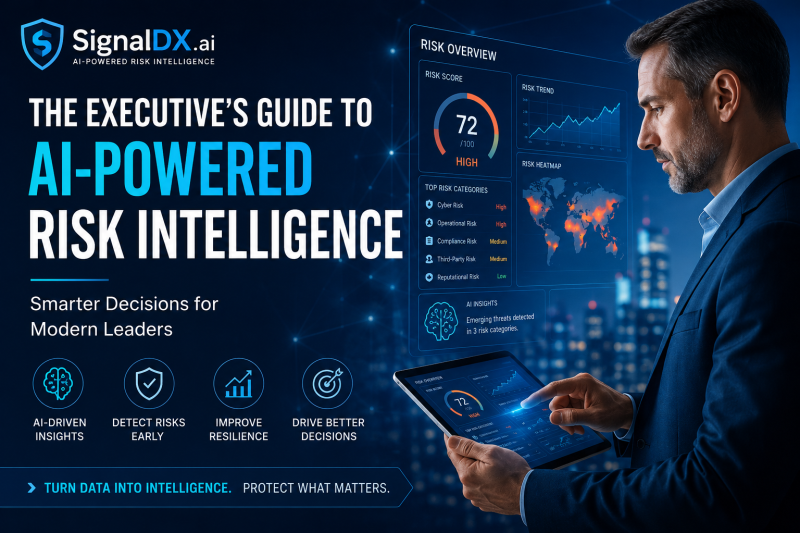
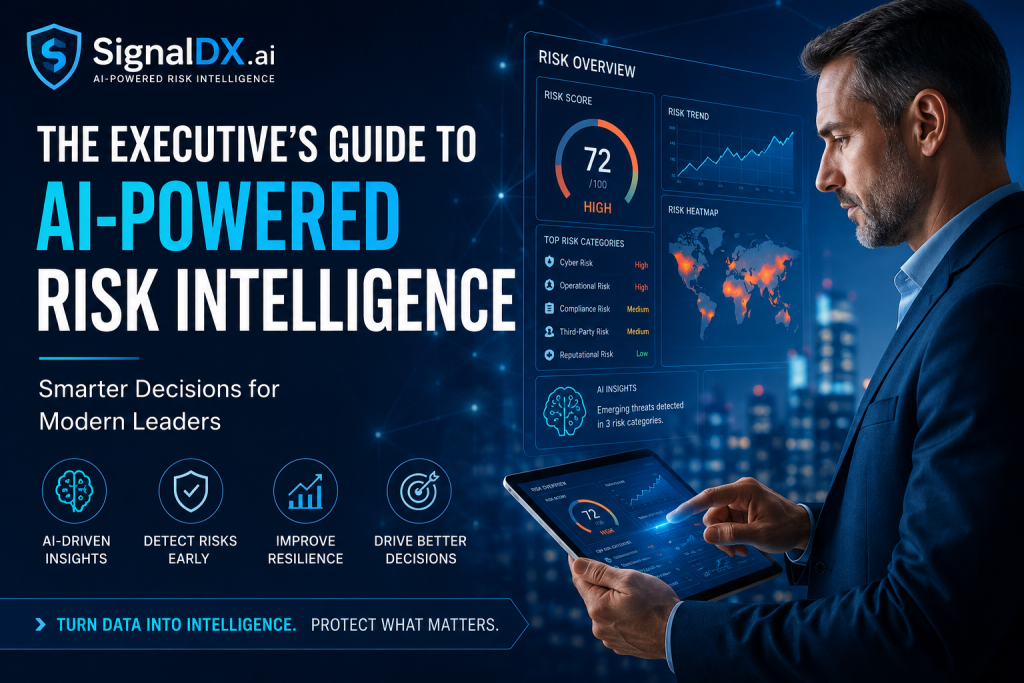
The Executive’s Guide to AI-Powered Risk Intelligence has become essential for organizations operating in an increasingly complex business environment. Modern enterprises face a growing number of interconnected risks, including cyber threats, regulatory changes, geopolitical uncertainty, supply chain disruptions, financial fraud, reputational damage, and operational failures. Traditional risk management methods often rely on manual reviews, disconnected data sources, and delayed reporting, making it difficult for executives to respond before issues become critical. AI-powered risk intelligence changes this approach by delivering continuous monitoring, predictive analytics, automated alerts, and actionable insights that support faster and more informed executive decisions.
SignalDX.ai empowers organizations to transform fragmented risk data into meaningful intelligence. Rather than reacting after problems occur, executives can proactively identify emerging threats, prioritize the most significant risks, and strengthen business resilience. This guide explores how AI-powered risk intelligence is reshaping executive leadership and why organizations that embrace intelligent risk management gain a competitive advantage.
How Automation Enhances Business Resilience has become one of the most important topics for organizations navigating an increasingly complex business environment. Companies today face cyber threats, supply chain disruptions, regulatory changes, operational inefficiencies, and financial uncertainty. Businesses that continue relying on manual processes often struggle to identify risks early, respond quickly, and maintain operational continuity. Automation provides a smarter way to manage these challenges while improving efficiency, reducing costs, and enabling better decision-making. SignalDX.AI helps organizations strengthen business resilience by automating risk intelligence, monitoring emerging threats, analyzing critical data, and delivering actionable insights that support continuous operations and long-term growth.
Modern organizations operate in an environment where disruptions occur more frequently than ever before. Digital transformation, evolving regulations, global supply chain dependencies, and growing cybersecurity threats require companies to remain agile. Business resilience is no longer limited to disaster recovery plans. It has become an ongoing capability that allows organizations to anticipate risks, respond effectively, and recover rapidly while continuing to deliver value to customers.
Automation serves as the foundation of resilient enterprises because it removes repetitive manual work, improves operational visibility, accelerates response times, and supports consistent decision-making. Combined with artificial intelligence, automation empowers organizations to detect problems before they escalate into costly business disruptions.
The Business Value of Automated Risk Monitoring has become increasingly important for organizations that need to identify threats before they disrupt operations, damage reputations, or create financial losses. As businesses generate more data and face more complex regulatory requirements, manual risk management is no longer sufficient. Modern enterprises require intelligent, continuous monitoring that delivers real-time visibility into emerging risks across operations, vendors, cybersecurity, compliance, finance, and supply chains.
SignalDX.AI helps organizations transform traditional risk management into a proactive business strategy. Instead of relying on spreadsheets, periodic audits, or delayed reporting, businesses can leverage AI-powered monitoring to detect anomalies, identify vulnerabilities, prioritize threats, and provide executives with actionable intelligence. The result is stronger governance, faster decision-making, improved compliance, and measurable business value.
How SignalDX.AI Helps Organizations Stay Ahead of Emerging Risks has become one of the most important questions for modern businesses operating in an increasingly unpredictable environment. Organizations today face rapidly evolving threats that range from financial crime and regulatory changes to cybersecurity incidents, geopolitical disruptions, supply chain vulnerabilities, reputational damage, and operational risks. Traditional risk management methods often struggle to keep pace because they rely heavily on manual monitoring, fragmented data, and reactive decision-making. SignalDX.AI changes this approach by combining artificial intelligence, automation, and continuous intelligence into one powerful platform that helps organizations identify, assess, and respond to emerging risks before they become costly business problems.
Companies that embrace proactive risk intelligence gain a significant competitive advantage. Rather than reacting after an incident occurs, they build resilience through early detection, continuous monitoring, and actionable insights. SignalDX.AI empowers enterprises with real-time visibility into changing risk landscapes, allowing executives, compliance teams, security professionals, and risk managers to make informed decisions faster and with greater confidence.
Laboratory organizations operate in one of the most complex areas of healthcare revenue cycle management, where even small coding mistakes can result in delayed reimbursements, claim denials, compliance risks, and financial losses. Best Practices for Laboratory Coding Accuracy are no longer optional for diagnostic laboratories that want to improve operational efficiency and maintain regulatory compliance. With increasingly complex CPT coding, ICD-10 requirements, payer-specific rules, and changing healthcare regulations, laboratories need intelligent solutions that help eliminate coding errors before claims are submitted. SignalDX.ai empowers laboratories with AI-driven risk intelligence, automated coding validation, compliance monitoring, and real-time analytics that significantly improve laboratory coding accuracy while reducing administrative burden.
Why Best Practices for Laboratory Coding Accuracy Matter
Accurate laboratory coding is the foundation of successful reimbursement. Every laboratory test performed must be documented correctly, assigned the proper CPT codes, supported with appropriate ICD-10 diagnosis codes, and comply with payer-specific billing policies. Even highly experienced billing teams can struggle to keep pace with evolving regulations.
Healthcare organizations lose millions of dollars every year because of preventable coding errors. Incorrect coding creates claim denials, reimbursement delays, audit risks, patient dissatisfaction, and compliance penalties. Following Best Practices for Laboratory Coding Accuracy helps laboratories establish standardized workflows that improve financial performance while protecting organizational reputation.
SignalDX.ai provides laboratories with intelligent monitoring capabilities that identify coding risks early, allowing billing teams to resolve issues before claims reach payers.
Understanding Laboratory Coding Accuracy in Modern Healthcare
Laboratory coding involves much more than assigning procedure codes. It requires clinical understanding, documentation review, payer knowledge, and regulatory awareness.
Each laboratory claim must accurately represent the services performed while matching medical necessity documentation. Coding professionals must verify physician orders, patient diagnoses, laboratory procedures, modifiers, specimen collection information, and payer requirements before claims are submitted.
Accurate coding ensures:
Higher reimbursement rates
Reduced claim denials
Improved compliance
Lower audit exposure
Better revenue cycle performance
Faster payment processing
SignalDX.ai enhances these processes by automatically identifying inconsistencies that may otherwise remain unnoticed until claims are denied.
Best Practices for Laboratory Coding Accuracy Start with Complete Documentation
Documentation remains the single most important component of coding accuracy.
Laboratory professionals should ensure every claim contains complete clinical documentation that supports medical necessity. Missing documentation frequently leads to rejected claims and regulatory concerns.
Essential documentation includes physician orders, patient demographics, diagnosis information, specimen details, performed tests, medical necessity records, and complete clinical notes.
When documentation is standardized throughout laboratory workflows, coding professionals spend less time searching for missing information while improving coding consistency.
SignalDX.ai continuously monitors documentation quality and identifies missing elements before billing begins.
Best Practices for Laboratory Coding Accuracy Using Correct CPT Codes
Current Procedural Terminology (CPT) codes change regularly. Laboratories that rely on outdated coding references increase the likelihood of billing errors.
Coding teams should review CPT updates annually while maintaining current coding resources. Regular education ensures coders correctly identify new laboratory procedures and retired codes.
Accurate CPT coding requires understanding:
Test methodology
Panel testing
Molecular diagnostics
Pathology procedures
Genetic testing
Specialized laboratory services
SignalDX.ai assists laboratories by validating CPT code selections against current regulatory guidance and internal coding policies.
Best Practices for Laboratory Coding Accuracy with Proper ICD-10 Selection
Diagnosis coding directly affects reimbursement.
A laboratory test may be technically correct, but if the supporting ICD-10 diagnosis does not establish medical necessity, the payer may deny reimbursement.
Laboratory coding teams should confirm diagnosis codes accurately reflect physician documentation and payer requirements.
Routine diagnosis validation reduces:
Medical necessity denials
Incomplete documentation
Coding inconsistencies
Compliance violations
Revenue leakage
SignalDX.ai automatically evaluates diagnosis-code relationships and highlights potential conflicts before claims are submitted.
Improving Laboratory Coding Accuracy Through Staff Education
Healthcare regulations evolve continuously.
Successful laboratories invest in ongoing coding education instead of relying solely on annual training sessions.
Continuous education should cover:
Updated CPT changes
ICD-10 revisions
CMS guidance
Private payer policies
Compliance updates
Documentation standards
Coding specialists who receive consistent education make fewer errors and adapt more quickly to regulatory changes.
SignalDX.ai complements training efforts by identifying recurring coding patterns that indicate additional educational opportunities.
How Artificial Intelligence Improves Laboratory Coding Accuracy
Artificial intelligence has become an essential tool for modern healthcare revenue cycle management.
Rather than replacing coding professionals, AI enhances their decision-making by reviewing thousands of coding variables in seconds.
AI-powered coding intelligence provides:
Real-time validation
Pattern recognition
Documentation analysis
Compliance monitoring
Risk detection
Automated alerts
SignalDX.ai uses advanced AI to evaluate laboratory claims before submission, helping organizations prevent denials instead of reacting to them later.
Best Practices for Laboratory Coding Accuracy and Medical Necessity Validation
Medical necessity remains one of the leading causes of laboratory claim denials.
Every laboratory test should be supported by appropriate clinical justification.
Coding teams should verify:
Physician orders match requested tests.
Diagnosis codes support testing.
Clinical documentation explains necessity.
Payer coverage policies are satisfied.
Required modifiers are included.
SignalDX.ai continuously evaluates medical necessity rules and alerts staff when documentation does not support reimbursement requirements.
Standardizing Laboratory Coding Workflows
Standardized workflows reduce human variation.
Organizations with documented coding procedures experience fewer inconsistencies because every team member follows identical processes.
Workflow standardization should include:
Documentation review
Code verification
Diagnosis validation
Claim auditing
Quality assurance
Compliance review
SignalDX.ai integrates with standardized workflows by providing automated coding checkpoints throughout the billing lifecycle.
Reducing Claim Denials Through Coding Accuracy
Claim denials often originate from preventable coding mistakes.
Common denial reasons include:
Incorrect CPT codes
Invalid ICD-10 combinations
Missing modifiers
Documentation deficiencies
Duplicate claims
Expired payer policies
Reducing these errors significantly improves revenue cycle performance.
SignalDX.ai identifies denial trends and helps laboratories implement proactive corrections before reimbursement is affected.
Best Practices for Laboratory Coding Accuracy in Molecular Diagnostics
Molecular diagnostics continue to grow rapidly, bringing greater coding complexity.
Revenue integrity depends on accurate coding, complete documentation, and proactive monitoring.
SignalDX.ai provides detailed analytics that reveal hidden revenue opportunities and recurring coding issues.
Data Analytics Support Better Laboratory Coding Decisions
Modern laboratories generate enormous volumes of operational data.
Analyzing this information helps leaders identify trends affecting coding accuracy and financial performance.
Analytics reveal:
Denial patterns
High-risk procedures
Coding inconsistencies
Documentation deficiencies
Payer-specific challenges
Revenue opportunities
SignalDX.ai transforms laboratory data into actionable intelligence that supports continuous coding improvement.
The Role of Quality Assurance in Laboratory Coding Accuracy
Quality assurance programs create accountability.
Regular reviews encourage coding consistency while identifying opportunities for process refinement.
Quality assurance initiatives should include peer reviews, documentation assessments, coding accuracy measurements, and compliance evaluations.
SignalDX.ai provides real-time dashboards that allow leadership teams to monitor coding quality across the organization.
Laboratory Coding Accuracy for Multi-Location Laboratory Networks
Large laboratory networks often struggle with coding consistency across multiple facilities.
Different locations may interpret coding policies differently unless standardized governance exists.
Centralized coding policies supported by AI-driven validation improve consistency throughout the organization.
SignalDX.ai enables enterprise-wide visibility, allowing leadership to monitor coding performance across every laboratory location.
Future Trends in Laboratory Coding Accuracy
Healthcare coding will continue becoming more data-driven.
Artificial intelligence, predictive analytics, automated compliance monitoring, and machine learning will increasingly support coding professionals instead of replacing them.
Future laboratory coding environments will emphasize:
Predictive denial prevention
Continuous compliance monitoring
Real-time coding validation
Intelligent documentation review
Automated workflow optimization
Advanced payer analytics
SignalDX.ai is designed to support laboratories through these evolving technologies while helping organizations remain prepared for future regulatory changes.
Why SignalDX.ai Supports Best Practices for Laboratory Coding Accuracy
Healthcare organizations require more than traditional coding software.
They need intelligent platforms capable of continuously monitoring coding quality, identifying emerging risks, and providing actionable recommendations before reimbursement problems occur.
SignalDX.ai combines artificial intelligence, compliance intelligence, workflow automation, predictive analytics, and revenue cycle monitoring into a unified platform that empowers laboratory teams to improve coding accuracy with confidence.
Rather than reacting to denials after they occur, laboratories can proactively identify vulnerabilities, strengthen compliance, improve documentation quality, and maximize reimbursement.
As laboratory testing continues to expand across molecular diagnostics, genetic testing, pathology, and specialized clinical services, intelligent coding support becomes increasingly valuable.
Organizations using SignalDX.ai gain greater visibility into coding performance while improving operational efficiency, regulatory compliance, and financial outcomes.
Conclusion
Implementing Best Practices for Laboratory Coding Accuracy is essential for laboratories seeking sustainable financial performance, regulatory compliance, and operational excellence. Accurate coding directly influences reimbursement, patient satisfaction, audit readiness, and revenue cycle efficiency. By combining standardized workflows, ongoing staff education, comprehensive documentation, automated validation, and intelligent analytics, laboratories can significantly reduce coding errors and prevent costly claim denials.
SignalDX.ai helps laboratories modernize coding operations with AI-powered risk detection, real-time compliance monitoring, predictive analytics, and automated validation that improve coding quality across every stage of the revenue cycle. As healthcare regulations continue evolving, organizations that invest in intelligent coding solutions will be better positioned to improve reimbursement, strengthen compliance, and deliver long-term operational success.
In today’s rapidly changing business environment, The Benefits of Intelligent Risk Monitoring Across the Enterprise have become impossible for organizations to ignore. Companies face an expanding range of risks, from cyber threats and regulatory changes to supply chain disruptions, financial crime, third-party vulnerabilities, and reputational damage. Traditional risk management approaches often rely on manual reviews, disconnected data sources, and reactive decision-making, making it difficult to identify emerging threats before they escalate. SignalDX.ai empowers organizations with intelligent risk monitoring that continuously analyzes risk indicators, delivers real-time insights, and helps leadership make faster, more informed decisions. By transforming fragmented data into actionable intelligence, enterprises can improve compliance, strengthen governance, and build resilience across every business function.
Understanding The Benefits of Intelligent Risk Monitoring Across the Enterprise
The modern enterprise generates enormous amounts of operational, financial, regulatory, and external intelligence data every day. Hidden within this information are indicators that can reveal potential risks before they become costly incidents.
The Benefits of Intelligent Risk Monitoring Across the Enterprise extend beyond identifying isolated issues. Intelligent monitoring provides a comprehensive view of enterprise-wide risk by connecting information from multiple internal and external sources. Instead of waiting for periodic audits or compliance reviews, organizations receive continuous visibility into changing risk conditions.
SignalDX.ai combines artificial intelligence, automation, and advanced analytics to help organizations identify emerging threats, prioritize high-risk events, and provide leadership with timely recommendations that support proactive risk management.
Why Enterprise Risk Is Becoming More Complex
Business risk has evolved significantly over the past decade. Organizations now operate within highly interconnected ecosystems that include suppliers, vendors, contractors, partners, regulators, financial institutions, and global markets.
Every new relationship introduces additional exposure. Regulatory frameworks continue to expand while cybercriminals become increasingly sophisticated. Geopolitical instability, environmental disruptions, sanctions updates, and adverse media events further increase uncertainty.
This complexity makes manual monitoring nearly impossible. Enterprise leaders require intelligent systems capable of processing thousands of data points continuously while highlighting only the risks that truly require attention.
SignalDX.ai enables organizations to monitor evolving threats automatically while eliminating the delays associated with manual investigations.
How Intelligent Risk Monitoring Works
Intelligent risk monitoring combines artificial intelligence, machine learning, natural language processing, and automated data analysis to evaluate multiple sources of information simultaneously.
Instead of relying on scheduled reports, intelligent monitoring continuously scans structured and unstructured data including regulatory updates, sanctions lists, adverse media, corporate records, financial information, operational metrics, cybersecurity alerts, and third-party intelligence.
SignalDX.ai transforms these diverse information sources into meaningful risk signals, allowing organizations to understand where exposure exists, how risks are changing, and what actions should be taken immediately.
The result is faster detection, greater accuracy, and significantly improved decision-making.
The Benefits of Intelligent Risk Monitoring Across the Enterprise for Executive Leadership
Executive leaders need accurate information without overwhelming complexity.
Traditional reporting often presents outdated information that no longer reflects current conditions. Intelligent monitoring provides leadership teams with dynamic dashboards, real-time alerts, and prioritized recommendations.
SignalDX.ai enables executives to understand enterprise-wide exposure without manually reviewing thousands of records.
Leadership gains confidence knowing that emerging threats are continuously monitored while strategic decisions are supported by accurate and current intelligence.
The Benefits of Intelligent Risk Monitoring Across the Enterprise for Compliance Teams
Compliance professionals face growing pressure to satisfy evolving regulatory requirements while managing limited resources.
Manual compliance monitoring consumes valuable time and increases the possibility of overlooking important changes.
Automated monitoring helps compliance teams identify issues earlier, document investigations more efficiently, and demonstrate ongoing compliance during regulatory audits.
This proactive approach significantly reduces compliance gaps while improving operational efficiency.
Improving Third-Party Risk Management
Third-party relationships remain one of the largest sources of enterprise risk.
Suppliers, vendors, consultants, distributors, and business partners all introduce varying levels of financial, operational, legal, cybersecurity, and reputational exposure.
SignalDX.ai continuously evaluates third-party relationships using multiple intelligence sources rather than relying solely on onboarding assessments.
If a vendor experiences financial distress, becomes subject to sanctions, appears in adverse media, or faces regulatory investigations, organizations receive immediate notifications that support faster decision-making.
Continuous monitoring replaces outdated annual reviews with ongoing risk intelligence.
Enhancing Adverse Media Monitoring
Negative news can quickly damage an organization’s reputation if emerging issues go unnoticed.
Traditional news monitoring often misses critical developments because analysts cannot manually review every publication across multiple regions and languages.
SignalDX.ai automatically monitors adverse media from trusted global sources, identifying relevant information related to vendors, customers, executives, suppliers, and business partners.
Organizations gain earlier awareness of developing situations, enabling faster responses before issues become larger reputational crises.
Strengthening Sanctions Screening
Sanctions regulations continue to evolve as governments update restricted entities and individuals.
Organizations operating internationally must ensure that customers, vendors, and business partners remain compliant with changing sanctions requirements.
SignalDX.ai automates sanctions screening using continuously updated intelligence sources, reducing manual effort while improving accuracy.
Real-time monitoring helps organizations minimize regulatory exposure while supporting international business operations with greater confidence.
Supporting Financial Crime Prevention
Financial crime continues to evolve alongside digital transformation.
Money laundering, fraud, corruption, bribery, and organized financial crime create significant regulatory and operational challenges.
SignalDX.ai helps organizations identify suspicious patterns earlier by combining behavioral analysis, risk indicators, adverse media, sanctions intelligence, and third-party monitoring into a unified risk platform.
Intelligent monitoring enables investigators to prioritize high-risk activities instead of reviewing every transaction manually.
This improves efficiency while reducing investigation costs.
Building Enterprise-Wide Visibility
One of the greatest challenges in enterprise risk management is fragmented information.
Different departments often maintain separate systems that prevent leadership from understanding organizational exposure as a whole.
SignalDX.ai consolidates information across compliance, procurement, finance, legal, cybersecurity, operations, and executive management into a centralized risk intelligence platform.
Unified visibility enables organizations to identify interconnected risks that would otherwise remain hidden.
Better collaboration results in faster mitigation and stronger governance.
The Benefits of Intelligent Risk Monitoring Across the Enterprise for Cybersecurity
Cybersecurity teams generate enormous volumes of security alerts every day.
Without intelligent prioritization, analysts struggle to identify genuine threats among countless notifications.
SignalDX.ai enhances cybersecurity by correlating cyber intelligence with broader enterprise risk indicators.
Security teams gain greater context regarding vendors, business operations, geopolitical events, regulatory changes, and external intelligence.
This integrated perspective supports faster incident response and more effective security planning.
Supporting Better Risk-Based Decision Making
Organizations make thousands of strategic decisions every year.
Whether entering new markets, selecting suppliers, approving acquisitions, or onboarding customers, decision-makers require reliable intelligence.
SignalDX.ai provides decision support through continuous risk monitoring that evaluates changing business conditions.
Executives no longer depend solely on historical reports because intelligent monitoring delivers current insights based on real-time information.
This improves confidence while reducing uncertainty.
Improving Operational Resilience
Unexpected disruptions can interrupt operations within minutes.
Natural disasters, cyberattacks, geopolitical conflicts, supplier failures, regulatory enforcement, labor shortages, and infrastructure issues all create operational risk.
SignalDX.ai continuously monitors changing conditions that may affect organizational resilience.
Organizations receive early warnings that support contingency planning before disruptions significantly impact business operations.
Proactive preparation minimizes downtime while protecting customer service and financial performance.
Accelerating Due Diligence
Traditional due diligence often requires extensive manual research across multiple information sources.
Analysts spend valuable time reviewing corporate records, financial statements, litigation history, regulatory databases, sanctions lists, and media reports.
SignalDX.ai automates much of this research through intelligent monitoring and data aggregation.
Due diligence teams complete investigations faster while improving consistency and reducing human error.
Organizations can evaluate more opportunities without increasing staffing requirements.
Supporting Enterprise Governance
Strong governance depends on reliable information.
Board members and executive committees require accurate reporting regarding enterprise exposure, emerging threats, compliance activities, and mitigation efforts.
SignalDX.ai delivers comprehensive governance dashboards that summarize organizational risk using meaningful metrics instead of overwhelming reports.
Leadership gains better visibility into changing conditions while supporting informed strategic oversight.
Improving Audit Readiness
Regulatory audits often require extensive documentation demonstrating continuous monitoring and compliance activities.
Manual record collection consumes significant resources and increases preparation time.
SignalDX.ai maintains comprehensive monitoring records, investigation histories, risk assessments, and automated reporting that simplify audit preparation.
Organizations demonstrate ongoing compliance more efficiently while reducing administrative workload.
Reducing Manual Work Across Risk Functions
Risk professionals frequently spend substantial time collecting information rather than analyzing it.
SignalDX.ai automates repetitive monitoring activities, allowing specialists to focus on investigation, analysis, and strategic planning.
Automation increases efficiency while improving consistency throughout the organization.
Enabling Predictive Risk Intelligence
Historical reporting explains what happened yesterday.
Predictive intelligence helps organizations prepare for tomorrow.
SignalDX.ai uses artificial intelligence to identify emerging patterns, evolving trends, and developing threats before they become significant business problems.
Predictive monitoring enables organizations to shift from reactive response toward proactive prevention.
This transformation significantly strengthens enterprise resilience.
Supporting Digital Transformation Initiatives
Digital transformation introduces new technologies, vendors, cloud services, and operational processes.
While innovation creates opportunities, it also introduces additional risks.
SignalDX.ai ensures that modernization efforts remain aligned with enterprise governance by continuously monitoring digital ecosystems for evolving threats.
Organizations can innovate confidently while maintaining strong risk oversight.
Why Artificial Intelligence Makes Risk Monitoring Smarter
Artificial intelligence processes information at a scale impossible for manual teams.
Machine learning continuously improves detection accuracy by identifying relationships between diverse data sources.
Natural language processing analyzes news articles, regulatory publications, legal documents, and public information.
Automation performs repetitive monitoring tasks continuously without interruption.
SignalDX.ai combines these technologies into one intelligent platform that transforms complex data into practical business intelligence.
Creating a Proactive Risk Culture
Successful organizations recognize that risk management is everyone’s responsibility.
Continuous monitoring encourages collaboration across compliance, procurement, legal, finance, operations, cybersecurity, and executive leadership.
SignalDX.ai provides shared visibility that enables departments to work together using consistent information and common priorities.
This collaborative approach strengthens organizational resilience while improving strategic alignment.
The Future of Intelligent Enterprise Risk Monitoring
Enterprise risk will continue evolving alongside technology, regulation, and global business operations.
Organizations that rely solely on manual monitoring will struggle to keep pace with increasing complexity.
Artificial intelligence, automation, predictive analytics, and continuous intelligence will become essential components of modern enterprise risk management.
SignalDX.ai is positioned to help organizations embrace this future by providing scalable, intelligent monitoring that adapts as business environments change.
Companies investing in intelligent monitoring today will be better prepared for tomorrow’s regulatory expectations, operational challenges, and strategic opportunities.
Conclusion
The Benefits of Intelligent Risk Monitoring Across the Enterprise extend far beyond traditional compliance activities. Intelligent monitoring enables organizations to identify threats earlier, improve governance, strengthen regulatory compliance, reduce operational risk, and make better strategic decisions based on real-time intelligence. As enterprise risks continue to grow in complexity, organizations need technology that delivers continuous visibility instead of periodic snapshots. SignalDX.ai empowers enterprises with AI-driven risk intelligence that transforms fragmented data into actionable insights, helping businesses stay resilient, compliant, and prepared for an increasingly dynamic risk landscape.
Suggested SEO Keywords: The Benefits of Intelligent Risk Monitoring Across the Enterprise, intelligent risk monitoring, enterprise risk monitoring, AI risk intelligence, SignalDX.ai, enterprise risk management, continuous risk monitoring, third-party risk management, adverse media monitoring, sanctions screening, compliance monitoring, due diligence automation, operational risk management, predictive risk intelligence, governance and compliance, AI-powered risk management, regulatory compliance software, enterprise compliance platform, business risk intelligence, automated risk monitoring.